Wednesday, March 16, 2011

Building ‘Sharpy’ Part 42


Momentum is very important when building a boat. Progress in action encourages the builder, but if you are an amateur boatbuilder you are unlikely to be at the job full-time – such full-timers can more easily generate momentum. I have a gut feeling that most amateur boatbuilders, enthusiasts like me can only turn their hand to their hobby when time presents itself. There are days, weeks and perhaps months when opportunities are far and few between for boatbuilding. That puts paid to momentum. Somehow, the odd hour has to be fitted in, so that the builder can see that the job is not dead, and that there could be light at the end of the tunnel.


Today, I managed to squeeze in a little more than an hour, and, amazingly I cut 18 more lead pieces for making the keel weights. Altogether I have 46 pieces, which means I’m more than halfway to finishing those I shall need.


The repetitive process of cutting these pieces of lead reminds that there are a lot of duplicative dull tasks in boat building; therefore the boatbuilder has to stick at things, be consistent, endeavour to keep high standards and be determined to see the job through. As progress is made, spirits are lifted, and in the end there will be joy and satisfaction.

Tuesday, March 15, 2011

Building ‘Sharpy’ Part 41


Keel Weights


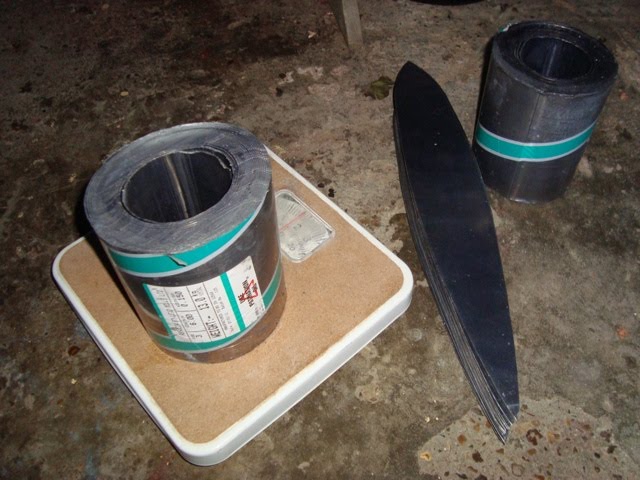
The saga of building the keel weights continues. I managed to find an hour-and-a-half for cutting more lead laminations. In fact, I ran out of lead after making a grand total of 28 pieces. Altogether they weigh 23 lbs – that’s according to the bathroom scales, which may not be accurate. 23 lbs is 10.43 kilos, and the total nominal weight of one roll of 6 metres of 6 inch Code 3 lead is 13 kilos; therefore the leftovers approximately weigh 2.57 kilos, i.e., 5.7 lbs. That’s quite a bit of wastage, but nothing can be done to make it any less.


From a total of three rolls of lead I should be able to make 84 laminates, each about 1.5 mm thick, giving a final thickness of 126 millimetres, which is 4.96 inches. The plans show the port hand weight is 2 and 3/16 inch thick and the starboard weight is 2 and 5/8 inches thick, giving a total width of 4 and 13/16 inches. In theory, this means I should have enough lead to finish the job.

Monday, March 14, 2011

Building ‘Sharpy’ Part 40


There was a flurry of activity today. Early this morning I rushed to the factory that was making the remainder of the metal parts for ‘Sharpy’, but I discovered it had gone bust! Consequently, I’ll have to find another metal fabricator who can do the job, or do it myself.


I then sped to Homebase where I found a length of hardwood for making capping pieces for the forward and aft edges of the keel. I managed to buy it for half price, because a section had wormworm in it, but the rest was excellent with a straight grain and no other blemishes.


Next I visited three suppliers of Code 3 lead flashing and paid £42.90 for 6 metres by 6 inches at the cheapest store.


Back at home I cut out the streamlined profile of the keel weight from a piece of paper, and used it to make a plywood template.


After I placed the template on the lead flashing I scored around the edges with a bradawl to mark the shape which I cut with a pair of scissors. I subsequently cut out 13 pieces of lead before I called it a day and downed tools. I shall need up to another 80 pieces for making the keel weights. The final number will be determined by the total weight of the lead pieces; the port weight must be 33 lbs, and the starboard one must be 40 lbs.

Sunday, March 13, 2011

‘Mirabaud’ Dismasted


Team sailors Dominique Wavre and Michèle Paret aboard their yacht ‘Mirabaud’ are competing in the Barcelona World Yacht Race. At the time of composing this, their dismasted yacht is in the Southern Atlantic Ocean about 650 nautical miles east of Argentina and 450 miles north of the Falkland Islands. The IMOCA Open 60 is under engine while riding out a storm. Neither of the crew is injured.


At 1640 UHT Michèle radioed the Race Officials at Barcelona informing them that the mast had failed. It had broken near the top, and due to the movement of the yacht this upper piece subsequently damaged spreaders below it. The crew therefore decided the best course of action was to bring the mast down in a controlled way to avoid further serious damage. They achieved this, but not without damaging some of the stanchions.


When sea conditions permit, they plan to set up a jury rig with the boom which they managed to save. Their intention is to sail towards Argentina. Meanwhile, the leaders, Jean-Pierre Dick and Loïck Peyron, aboard Virbac-Paprec 3 are 1,085 miles south of the Equator, and their nearest rivals, Iker Martinez and Xabi Fernandez, aboard MAPFRE are 345 miles behind.


Links


Barcelona World Race

http://www.barcelonaworldrace.org/en/

http://bills-log.blogspot.com/2011/03/barcelona-world-race.html


‘Mirabaud’

http://www.dominiquewavre.org/en/

Saturday, March 12, 2011

Building ‘Sharpy’ Part 39


Well, everything went as planned last evening. I set up the Black and Decker workbench in the kitchen and prepared the area for applying Evo-stik to both sides of the marine ply panel and to the inner surfaces of the two pieces of aluminium. Before spreading the Evo-stik on the respective surfaces I lightly sanded them and vacuum cleaned them. To clean the surfaces of the aluminium pieces I swabbed them with Acetone soaked in kitchen roll. This removed minute particles from the metal, so as to provide a perfectly clean, dry surface for the adhesive. I made sure that my hands didn’t come into contact with the Acetone and Evo-stik by wearing rubber gloves.


When the aluminium pieces were in place I clamped the whole lot together, paying particular attention to the edges, ensuring they were tightly bonded. I found the most effective way of spreading the Evo-stik was to first apply it with a spoon; then spread it evenly with a serrated plastic spreader that was supplied with the adhesive. Before parts were joined, I waited until the Evo-stik on both surfaces was touch-dry; this took approximately ten minutes. I was careful to ensure that the pieces were perfectly positioned before I joined them and applied hand pressure to seal the bond. The whole job was completed within an hour.


Fumes from the Evo-stik were not at all pleasant, and I was glad my wife was not home at the time. Before she returned, I opened the windows to allow the fumes to escape. This must have worked, because she did not mention that she could smell an obnoxious smell, as was the case when I was varnishing wooden bits for my daughter’s yacht a few days ago.

Friday, March 11, 2011

Building 'Sharpy' Part 38

Initial shaping


Early this afternoon I set about shaping the marine plywood for the keel. I used one of the aluminium pieces as a template; then I cut out the plywood with a jigsaw. The job only took an hour, including the final shaping with a plane and sandpaper.

Planed and sanded

This evening I intend bonding the ‘sandwich’ together with Evo-stik impact adhesive. The original ‘Sharpy’ keel was sandwiched in this way, and it is still going strong after several years. I questioned Derek Munnion, the designer of the boat, to assure myself before joining the parts that I would do it correctly. He did not advise scoring the wood, or severely abrading the aluminium parts. He used a plastic kitchen scouring pad to slightly roughen surfaces of the aluminium parts that would come into contact with the Evo-stik. He also cleaned the metal surfaces with white spirit before spreading the adhesive. I think I shall clean them with acetone in preference to white spirit. Derek slightly sanded and vacuum cleaned the plywood surfaces, and I shall do the same.

The sandwich

Finally, I’ll clamp them together to ensure they are properly bonded.


My next job will be making a template for cutting the sheet lead pieces that will be laminated together with Evo-stik to form the keel weights. These will be streamlined like a torpedo or fish.

Thursday, March 10, 2011

Thomas Colville and ‘Sodebo’


‘Sodebo’ is a 32 metre (105 ft) Maxi trimaran designed by Nigel Irens and Benoît Cabaret. She is currently being sailed solo around the world by Thomas Colville in an attempt to become the record holder for the fastest non-stop solo circumnavigation. Francis Joyon, the current holder, did it aboard IDEC (29.7 metre trimaran) in 57 days, 13 hours and 6 seconds.


Colville stands a chance of achieving his goal, but only if he pushes his trimaran hard without damaging the vessel and exhausting himself. To beat Joyon’s record he will need to average a speed of no less than 20 knots over the complete course. At the time of writing this, he has just over 17 days to complete a record-breaking circumnavigation. By comparison with Joyon’s position when doing his solo record, Colville is only 489.5 miles behind, and he has 6,213.6 miles to sail, which means he has to achieve 365.5 miles a day, at an average speed of 15.2 knots. Providing he doesn’t get stuck in the Doldrums he stands a very good chance.


Links


Sodebo

http://www.sodebo-voile.com/


Sodebo reaches Halfway Point

http://www.sailing.org/35445.php

http://ecomyachting.com/blog/2011/03/02/sodebo-reaches-halfway-point/


Trimaran Sodebo

http://www.sodebo-voile.com/actu/news/721-NEWS-CAPE-OF-GOOD-HOPE-ASTERN.html


Sodebo Rounds Horn

http://www.sailing.org/35559.php


Sailing Round Cape Horn

http://yachtpals.com/sailing-cape-horn-9207


Fastest Solo Circumnavigator

http://www.solarnavigator.net/francis_joyon_24
_hour_distance_record_single_handed.htm


Francis Joyon and IDEC

http://www.trimaran-idec.com/francis_joyon_portrait.asP

Wednesday, March 09, 2011

Master Boatbuilder

'Isolde'

Now and again when surfing the Internet you come across something that registers in your mind. You think of it when you least expect. One such website made an impression on me, not because it was scintillating or exciting, but because its pages tell a story of a remarkable man who is very humble about his achievements. His love is working with wood, doing joinery and boatbuilding. His name is Mark Harris. He says that over the past ten years he has had a variety of jobs, including theatre set design and construction, green oak timber framing, fitting out narrow boats, and along with other things, building replicas of Victorian railway carriages. He studied boatbuilding at Falmouth and gained a City and Guilds qualification for the same, before setting up his own business building traditional boats, sailing and selling boats.

By Pontoon

Now all this information can be found on his website at http://www.woodenboatbuilding.co.uk/index.html , but more remarkably there are photos of some of the boats he has built and renovated. A very beautiful sailing yacht of his is ‘Isolde’, which would appear to be for sale. She’s modelled on the lines of a Mevagissey tosher. You must have a look at a fascinating time lapse video* showing how she was built. The photo gallery contains stills taken of the boat during the building process. You can’t fail to be impressed with the quality of workmanship.

Interior

I took a look at the page about the restoration of ‘Lady Hamilton’, a Helford fishing boat that had been severely damaged in a collision and sank. How she was brought back to life is a miracle, considering the extent of the damage. Mark and two others were involved in putting her right. Just take a peek at photos illustrating the laid deck of ‘Marguerite’, a Bristol Channel Pilot Cutter that Mark and Barnaby Shepard jointly renovated, which included the removal and filling of half a mile of deck seams. Then there’s the work on the beautiful ‘Monie’, Vertue number 3 that he and Barnaby completely refitted – even the interior was removed and put back in place.


Mark does not advertise himself as a Master Boatbuilder, but he does have the skills of one, and it’s a joy to look through his website photo gallery illustrating projects he has undertaken.


Links


*Time lapse video of the building of ‘Isolde’

http://www.woodenboatbuilding.co.uk/html/timelapse.html


Video clip of ‘Isolde’ sailing off St Anthony’s Head

http://www.woodenboatbuilding.co.uk/html/sailing.html

Tuesday, March 08, 2011

Varnishing bits of 'Ladybird'

Bits in the box room

Another splendid sunny day has made if possible for me to do a good many things such as get rid of the of the hedge trimmings, rose pruning and unwanted bulbs etc., that my wife accumulated yesterday, besides cutting the lawns and, most importantly, varnish ‘Ladybird’s’ rudder stock, tiller and two washboards. The latter activity required a little diplomacy, because I set up the items for varnishing in the kitchen where it was warm. I thought I was going to get away with it, but my better half caught one whiff of the Blakes varnish, and she made it clear that she disapproved. She obviously found the smell obnoxious. To me, it was pure joy. As I inhaled the decongestant my sinuses were cleared, and I felt great, but to address my wife’s concern I opened the kitchen windows for the ‘fumes’ to disperse, then I transferred everything to the upstairs box room. That’s where I should have set up the items for varnishing in the first place.


All’s well that ends well. Love and peace reign.

Blakes Classic Varnish


Blakes Classic Varnish warrants a mention, because it is so good. Words printed on the tin’s label state that it is a ‘Traditional varnish containing tung oil for an uncompromising finish’. Apparently this oil comes from the pressed nuts of tung trees, and when exposed to air it dries with a transparent plastic-like surface. I have used Blakes Classic Varnish on my previous yachts, preferring it to other brands. I find that this tung oil varnish flows smoothly from the brush, covers very well and adheres to previous layers. Unlike some varnishes, it does not flake off when attacked by the sun.


Links


Tung Oil

http://en.wikipedia.org/wiki/Tung_oil


Blakes Classic Varnish (£18.38 for 750 ml)

http://marinestore.co.uk/HA5311.html

Monday, March 07, 2011

Rehearsal for Boatbuilding


The weather has turned fine for a few days. Sunshine does wonders for me. Therefore I was inspired to get outside, set up the workbench and sand ‘Ladybird’s’ rudder in preparation for applying a coat of varnish to the stock and antifouling to the blade.


I also repaired the lower washboard where the edge piece was coming adrift from the panel. All I had to do was remove dirt and old varnish that had been trapped between the parts; apply epoxy to the cleaned and scored surfaces; then clamp and screw them together. Because the air temperature was too cold for epoxying, I did that part in the kitchen. My wife was suitably engaged in the garden, pruning roses, trimming shrubs and hedges, which meant I had the kitchen to myself – very convenient! I’m always an opportunist. My motto is doing things when you can. Don’t procrastinate.


Repairing the washboard and preparing the rudder only took a couple of hours. That’s an advantage of owning a small boat, because painting and varnishing seldom takes more than a few hours. I suppose the largest area that needs attention is below the waterline, which includes the twin keels and the rudder. The total area requiring antifouling can be no more than 17 square metres, probably less. Lightly sanding the bottom prior to antifouling will be my worst job. Unless I can have ‘Ladybird’ raised higher from the ground where she is laid-up, it will be a difficult task. I’ll endeavour to arrange this closer to the launch date.


From past experience I have learnt not to strip away paint and varnish to the bare wood, because previous layers already protect the wood, providing they remain adhered to it. A light sanding is all that is required before applying one or two coats of varnish for the coming season. As long as rainwater has not seeped through the varnish to the wood, the old varnish will remain in tact, and the colouring of the wood will be unaffected. Inevitably, with a boat as old as ‘Ladybird’, woodwork will be tarnished, but as I have said, that’s perfectly OK, providing the varnish is in tact and there is no rot.


Working out of doors in the spring sunshine has been like a rehearsal for resuming the building of ‘Sharpy’, my latest project. She is a 15’ sharpie with a drop keel. My aim is to finish her in time for some sailing this year.


Links


‘Sharpy’

http://bills-log.blogspot.com/2011/02/sharpy-peep-show.html


‘Ladybird’

http://bills-log.blogspot.com/2011/02/check-on-ladybird.html

Sunday, March 06, 2011

YouTube Favourites

Ghost of 'Foncia' sailing at speed. For the real thing visit: http://www.youtube.com/watch?v=B3D_7vCowa8

YouTube has made a vast contribution to what is available for surfers of the Internet. Instead of static two-dimensional photos, the elements of three-dimensional movement, depth and colour greatly enriches our experience. For those of us have a good Broadband connection, we can watch High-Definition (HD) quality moving images on selected videos, i.e., videos created with an HD digital video camera running 720p, such as the Sanyo Xacti VPC – HD2. To watch HD on your computer you will need a Flash Player 10 or later version installed.


I have a lot of fun watching exciting YouTube clips featuring fast sailing vessels. These are often promotional films produced by professional cameramen for the purpose of publicizing sponsors who contribute towards the costs of building and maintaining yachts that participate in Ocean races, regattas and International events.


Here are links to some of my favourite YouTube videos – They are all videos of trimarans with the exception of one:


Trimaran 60 pieds – the trimaran ‘Foncia’ 3 years ago

http://www.youtube.com/watch?v=B3D_7vCowa8


Trimaran 60 pieds avec Alain Gautier – another one of ‘Foncia’ 2 years ago

http://www.youtube.com/watch?v=pdhz3iuYNU4


Sailing the Extreme Trimaran Sodeb'O

http://www.youtube.com/watch?v=1GuTs0KM1ZY


Francis Joyon The Globe Killer 3 years ago

http://www.youtube.com/watch?v=3m_9o_Bdtew


Hydroptere - world sailing record - 51 knots 1 year ago

http://www.youtube.com/watch?v=2boayPZ3GbE


Barcelona World Race: Feb 8 - Virbac Paprec3 Water and Wind 3 weeks ago

http://www.youtube.com/watch?v=XFHmlSJa6VQ


Maxi Tri Banque Populaire V at Very High Speed

http://www.youtube.com/watch?v=AP985PjMGts


Other Related Links


HD YouTube

http://www.squidoo.com/youtubehd


How to Watch All YouTube Videos in High Definition Tutorial!

http://www.youtube.com/watch?v=wJATNPJyx8w


HD Video

http://en.wikipedia.org/wiki/High-definition_video


HD Recording Formats

http://reviews.cnet.com/4520-6500_7-6637113-3.html


Details of the Sanyo Xacti VPC – HD Camera and CNET Review

http://reviews.cnet.com/digital-camcorders/sanyo-xacti-vpc-hd2/4505-6500_7-32307439.html?tag=rb_content;rb_mtx

Saturday, March 05, 2011

Happy Cat Inflatable Catamarans

Happy Cat Vision


In response to my article on the MiniCat 310 on 28th February, Paul Mullings kindly sent me a link to the home page of Grabner Sports who market two versions of their Happy Cat inflatable catamarans. Their longest running production boat is the Happy Cat Light; she has less sail area and a shorter mast than the 2011 boat, the Happy Cat Vision. The Light version is advertised as being suitable for beginners to experienced sailors. Although the hulls of both models are identical, the Vision is set up for more efficient sailing. With an extra 20% sail area and improved sail design, she is more of a performance boat that can be sailed to the limit by those seeking excitement.


Both boats meet the criteria for Category C vessels which means they are deemed to be suitable for use on lakes and coastal waters up to Beaufort Force 6. However, there is a caveat that in winds exceeding Force 4, they should be reefed. That may pose a problem for the Happy Cat Vision, because her mainsail does not have reef points. Perhaps her foresail would need to be taken in.


Links


My Article on the MiniCat 310

http://bills-log.blogspot.com/2011/02/minicat-310.html


Grabner Sports Happy Cats

http://www.happy-cat.at/index.php?id=2283&L=2

Friday, March 04, 2011

Herroshoff Haven 12 ½ and Mike Broome’s 20’ Day Sailer ‘Cirrus’

Photo from Sillette Marine Propulsion website - see link below


I was trawling through the links in the boats section of the Lyme Regis Boat Building Academy’s website when I came across a familiar day sailer that I had seen at Burnham-on-Crouch. In fact I had posted an article* to this Blog about her on 13th September, 2010. The name ‘Cirrus’ and the wonderful craftsmanship rang a bell. Here was the very boat I seen and touched. From the Academy’s website I learned she had been designed by Mike Broome, an instructor at the Academy, and she had been built there by Bob Hinks.

At Burnham-on-Crouch


When I wrote my Blog about ‘Cirrus’ I believed she had features similar to Nathanael Herreshoff’s Haven 12 ½ day boat which in fact had an overall length of 16’. Joel White’s interpretation of the design with a shallow keel had similar overall measurements. Mike Broome’s day sailer is 20’ from bow to stern. Instead of being rigged with a gaff mainsail, she has a tall Bermudan sail set on a metal mast. I hadn’t realised she was powered by an electric saildrive because I had assumed she was equipped with a small, lightweight modern diesel engine.

Graceful transom

I was enthralled with the Mike Broom day sailer because she was so well built, and her lines were a joy to my eye. I knew in my heart that I would never own her; indeed I would never have the pleasure of sailing her. If I allowed myself to covet a boat I would surely want her. Congratulations to Bob Hinks and any who had a part in building this fine day boat, and of course, well done to her designer who has captured the spirit of Herroshoff’s Haven 12 ½ by creating a vessel with similar endearing features, especially the sloping wineglass shaped transom and the fine curved bow.

Cleverly designed lifting rudder


Links


*Day Sailer

http://bills-log.blogspot.com/2010/09/day-sailer.html


Day Sailer designed by Mike Broome, an instructor at the Lyme Regis Boat Building Academy

http://www.boatbuildingacademy.com/students/cirrus-bob-hinks.


Sillette Marine Propulsions including saildrives. The site has photos of ‘Cirrus’

http://www.sillette.co.uk/gallery.html


Joel White version of Herreshoff’s Haven 12 ½ built by John Watson

http://www.boatbuildingacademy.com/students/studentprofilesmarch09/herreshoff-haven-john-watson.htm


Building a Herreshoff Haven 12 ½ by Joel White – being built by Alastair Gary Thompson at the Lyme Regis Boatbuilding Academy

http://herreshoffhavenbuild.blogspot.com/2011/01/moulds-are-now-set-up.html


Haven 12 ½ by Howard Boats – stripped planked + double diagonal veneers and GRP sheathing

http://www.howard-boats.com/links.htm


Landing School Boat’s page on the Haven 12 ½ - good photos

http://www.landingschoolboats.com/Haven.html


Specification of a Joel White Haven 12 ½

http://www.schleiffboatworks.com/haven.htm


Herreshoff Haven 12 ½ for Sale Gatsby Yachts $50,000

http://www.flickr.com/photos/intron/225672613/

Thursday, March 03, 2011

Traditional Wooden Boatbuilding


There’s boat building and there’s ‘real’ boat building. Any boats I have built come in the former category. The latter category comprises those that require skills and knowledge that I do not have. I have never built a clinker hull with steam bent ribs, for example, nor have I built a cold-moulded one over a frame. I have shied away from attempting even the most simple clinker dinghy, because of the amount of work required to build her and because of my diffidence about being able to do it. I’ve even avoided strip planking, which should not be too difficult, but having to prepare a supporting mould or frame before starting the hull proper, was enough to put me off.


When I see examples of wooden boats at the likes of the Beale Boat Show, I boggle at the craftsmanship, and I admire the skill of their builders. Any such vessel which has been crafted to perfection is a joy to see and a pleasure to touch. Wood is so appealing with its uniqueness, colour and texture. Today there are a variety of adhesives that can be employed for bonding wood; epoxies being much favoured because of their strength and capacity for filling voids when mixed with agents such as colloidal silica, Cab-o-sil or Microfibers. The traditional means for fixing planking to ribs or frames is to hold them together with copper nails and roves; elsewhere bronze or copper nails may be used. Caulking cotton and oakum can be employed for filling gaps, especially suitable for seams between planks on carvel vessels. Carvel hulls are occasionally splined, i.e., in-filled with thin wedges of wood which take the place of caulking.


If you want to learn how to build ‘real’ wooden boats you can do so by attending one of the UK boat building institutions such as the International Boat Building College at Lowestoft, or the Boat Building Academy at Lyme Regis. Depending on the course you select, from basic boat building to advanced, you will need between £6000 and £15,000 approximately to pay for tuition fees.


Links


International Boatbuilding College

http://www.ibtc.co.uk/


Boat Building Academy

http://www.boatbuildingacademy.com/


Partnership teaches traditional boa building skills

http://www.ltscotland.org.uk/video/p/video_tcm4497838.asp


Wooden Boat Building

http://www.woodenboatbuilding.co.uk/


Traditional Clinker Rowing/Sailing Boat

http://www.boatbuildingacademy.com/students/traditional-clinker-boat-bob-jennings.htm


DYS Wood Boat.Com - Wooden Boats at the Beale Park Boat Show 2009

http://www.diy-wood-boat.com/Wooden_Boats.html


Beale Park Boat Show

http://www.bealeparkboatshow.co.uk/

Wednesday, March 02, 2011

Ben Ainslie or Giles Scott?

Ainslie


Who will represent Great Britain in the Olympic Finn class at Weymouth in 2012? Will it be Ben Ainslie or Giles Scott, the up-and-coming talented sailor who was only 13 when Ben won his first gold medal at the Sydney Olympics in 2000?


The rules stipulate that there can only be one sailor representing each participating country. Sailors in the Finn class will be required to compete in 11 races, but they will be able to discard their worst result after completing five races. The winner of a race will score one point and the person coming second will score two points, and so on. The person who ends up with the least points scored over a series is the winner. Competition is fierce among today’s younger generation of sailors, but Giles Scott is proving his form by recently beating Ben at the Miami World Cup Regatta in the Finn Class and at the Sail for Gold Regatta last August.

Scott


However, past form and experience would indicate that Ben could be the one who will compete on behalf of his country. He has three Olympic gold medals to his credit: Sydney 2000 in the Laser class; Athens 2004 in the Finn class and Beijing 2008 in the Finn class. Ben has ample time to hone his skills and reach peak form before the showdown at Weymouth.* He is highly motivated to achieve something that has not been done before, i.e., win four gold medals in sailing events at the Olympics. The 34 year old, three times Sailor of the Year, Ben Ainslie, has a steely determination to succeed, but he does no underestimate the challenge posed by Giles. Both sailors badly want this medal, but only one of them will have the chance to realise their dream of becoming the Olympic Finn champion.

The determined eyes of Ben


*Notes

Sailing events at Weymouth will take place between 29th July and 11 August, 2012. The final Finn race on 5th August will reveal who gets the Gold.


Links


Ben Ainslie

http://www.benainslie.com/


Ben Ainslie Promo

http://www.youtube.com/watch?v=wavebpDWmd4&feature=player_embedded#at=112


Ben Ainslie

http://en.wikipedia.org/wiki/Ben_Ainslie


The Telegraph – Ben Ainslie

http://www.telegraph.co.uk/sport/othersports/olympics/8355509/London-2012-Olympics-Ben-Ainslie-ready-for-Games-qualification-battle-as-he-pursues-fourth-gold-medal.html


Ainslie eyeing return to form

http://uk.eurosport.yahoo.com/02032011/58/ainslie-eyeing-return-form.html


Giles Scott Achievements

http://gilesscott.co.uk/achievements


Giles Scott leads GB medal charge in Weymouth

http://news.bbc.co.uk/sport1/hi/other_sports/sailing/8914599.stm


Scott Giles pips Ben Ainslie in Miami World Cup Regatta

http://news.bbc.co.uk/sport1/hi/other_sports/sailing/9381270.stm


Giles Scott Biography

http://www.sailing.org/biog.php?memberid=40671


Pressure on Giles Scott to keep his advantage over Ben Ainslie

http://www.telegraph.co.uk/sport/othersports/sailing/ben-ainslie/7946999/Pressure-on-Giles-Scott-to-keep-his-advantage-over-Ben-Ainslie.html

Tuesday, March 01, 2011

Barcelona World Race

Jeanne-Pierre Dick, skipper of 'Virbac Paprec 3’

Iker Martinez, skipper of ‘Mapfre’


When I last looked at the website for the Barcelona World Race, Jean-Pierre Dick and Loïck Peyron racing ‘Virbac Paprec 3’ were in the lead; they were about 60 miles ahead of Iker Martinez and Xabi Fernandez in ‘Mapfre’.

‘Virbac Paprec 3’


‘Virbac-Paprec’ is a VPLP high-tech Ocean racing yacht designed by Guillaume Verdier, built in New Zealand. Innovative ideas incorporated into her include a twin coach roof which is comprised of two domed Plexiglass operation stations giving excellent all-round visibility. Minimal rigging with only one backstay and two sets of spreaders reduces weight aloft and minimizes drag when going to windward. Small advantages in terms of lightness, less wetted area, less air drag, all add up to make big differences over long distances. Such innovations could account for ‘Vibac-Paprec’s’ marginal lead over ‘Mapre’, but Dick and Peyron comprise a formidable team difficult to beat.

‘Mapfre’


The Spaniards’ Farr designed IMOCA yacht, ‘Mapfre’, is older in concept. Built in 2007 she was skippered by Michel Desjoyeaux when he won the Vendée Globe Race in 2008; therefore she is a proven boat. She also participated in the 2009 Istanbul Europa Race. She’s a good all-round yacht capable of performing well in a variety of sea conditions - not just downwind. These features could help immensely when proceeding northwards in the Southern Atlantic.


Just now the leaders are heading towards Cape Horn and they have a substantial one thousand three hundred or so miles lead over those behind. It’s like a two-horse race, but things could dramatically change after they round the Horn when they may encounter light winds, which would allow the others to reduce the gap.


Links


Barcelona World Race

http://www.barcelonaworldrace.org/en/index.php

http://www.barcelonaworldrace.org/en/


‘Verbac Paprec’ Team

http://www.barcelonaworldrace.org/en/bwr/teams/detail/virbac-paprec-3-157-3056


‘Mapfre’ Team

http://www.barcelonaworldrace.org/en/bwr/teams/detail/movistar-152-3192


‘Mapfre’

http://www.imoca.org/en/index.php/boats/view/mapfre1


VPLP

http://en.wikipedia.org/wiki/VPLP


VPLP Yacht Design

http://www.vplp.fr/flash/index_vplp-3.html


Jean Pierre Dick

http://www.jpdick.com/


Barcelona World Race: Feb 8 - Virbac Paprec 3 Water and Wind

http://www.youtube.com/watch?v=XFHmlSJa6VQ&feature=channel

Monday, February 28, 2011

MiniCat 310


Today I received a comment from Thomas who has a Facebook page for supporters of Laura Dekker. He pointed out that I had incorrectly stated in yesterday’s Blog that she would be attending the Amsterdam Boat Show in September. In fact she will be in attendance at the Boat Show from 1st to 6th March.


From Laura’s News page at her website I read that she had enjoyed sailing a MiniCat 310. I didn’t give this much thought until I visited Thomas’s Facebook page where I saw a photo of Laura and a friend sailing the MiniCat. (See the first link below, which takes you to a number of photos, including the one I’ve just mentioned.)


This miniature inflatable catamaran does indeed look like a load of fun. I like the fact that it can be packed in a bag which measures 1,350 x 300 x 400 millimetres and the total weight is only 35* kilograms. There are 3 options from which you can choose: the ‘Standard’ boat with one sail; the ‘Super’ version with a jib to go with the mainsail, or the ‘Sport’, which is like the ‘Super’ but it has a furling jib and a lighter mast.


This 3.1 metre by 1.4 metre catamaran that can be sailed by one or two people.


If you want more details, search the websites listed below.


*Depending on the version, the weight of the package can be between 35 and 38 kilograms.


Links


Photos from Zeilmeisje Laura Dekker

http://www.facebook.com/media/set/?set=o.107777619273164&ref=mf


Laura Dekker’s News Page (See entries for 21st and 22nd February, 2010)

http://www.lauradekker.nl/English/News.html


MiniCat The Boat that fits in your car

http://www.minicatamaran.eu/


MiniCat 310 Options

http://www.minicatamaran.eu/design310.html#


MiniCat Firebox.com

http://www.firebox.com/product/1839/MiniCat


MiniCat the Gadget Show

http://fwd.five.tv/gadgets/lifestyle/travel/minicat


MiniCat Sailinginfo 4 All

http://www.sailinginfo4all.co.uk/boattypes/minicat.htm

Sunday, February 27, 2011

Laura Dekker again


My first article about Laura Dekker was in September, 2009. At the age of 13, she had aspirations to become the youngest person to sail alone around the world. She met opposition from the authorities on account of her age, but she was a very determined youngster who was sure that she could accomplish her dream. Many people, including me, likened her to Abby Sunderland, Zac Sunderland and Jessica Watson, all of whom wanted to become the youngest solo non-stop circumnavigator of the globe, i.e, doing it without putting into port or setting foot on dry land. This was a misunderstanding brought about by the media. In fact Laura’s aspiration was never to sail around the world non-stop; indeed it was exactly the opposite. She wanted to visit interesting places, explore them and learn about people she would meet.


In her recent update to the News section of her website she makes it clear that she never intended to sail non-stop, and she also points out that if she is successful in completing a circumnavigation and becomes the youngest to do so, the Guinness Book of Records no longer includes a section on the ‘youngest’ to achieve anything. As far as she is concerned her record would stand in its own right, and I feel sure the majority of us would go along with that. The World Sailing Speed Record Council (WSSRC) responsible for monitoring and ratifying ocean sailing records would not approve and uphold her record because it is not their policy to encourage either the very young or the very old to embark on such voyages.


Laura was inspired by Tania Aebi and Robin Lee Graham by their around the world adventures. Tania was a novice sailor who set out from New York in 1985 and returned there in 1987. The following year she wrote ‘Maiden Voyage’, a book relating her experiences, which can be obtained from Amazon.com. (See link below) Robin Lee Graham took just under five years to complete his circumnavigation between 27th July, 1965, and 30th April, 1960. He also wrote a book detailing his voyages, which was the basis of the film ‘Dove’ with the same name; this was also the name of the boat he used for the greater part of his around the world adventures. On reaching St Thomas he sold ‘Dove’ and replaced her with a bigger yacht which he named ‘Return of Dove’.


Laura is not in a hurry, but she hopes to complete her adventure within two years, so as to sail at times when she will avoid hurricanes and make the best use of seasonal winds. She is content to briefly return home now and again and to have family visit her. She is booked to be a guest attraction at HISWA - the Amsterdam Boat Show which takes place 1st - 6th March, 2011.


Links


Laura Dekker

http://www.lauradekker.nl/

http://en.wikipedia.org/wiki/Laura_Dekker


Laura Dekker in the Canaries

http://www.youtube.com/watch?v=lo5QQvjm7V8&feature=player_embedded


Laura Dekker: the youngest person to sail the world solo

http://www.youtube.com/watch?v=baRwvEorvGU


Laura Dekker

http://bills-log.blogspot.com/2009/09/laura-dekker.html

Mike Perham, Jessica Watson, Abby Sunderland and Laura Dekker


http://bills-log.blogspot.com/2010/05/mike-perham-jessica-watson-abby.html


Tania Aebi

http://taniaaebi.com/


‘Maiden Voyage’ by Tania Aebi

http://www.amazon.com/Maiden-Voyage-Tania-Aebi/dp/0345410122


Robin Lee Graham

http://en.wikipedia.org/wiki/Robin_Lee_Graham


‘The Dove’ – a film about Robin Lee Graham’s Circunavigation

http://www.imdb.com/title/tt0071438/


‘Dove’ by Robin Lee Graham

http://www.amazon.co.uk/exec/obidos/ASIN/0060920475/nicksmicropages


HISWA – Amsterdam Boat Show

http://www.hiswatewater.nl/english/


ZEILMEISJE LAURA DEKKER ON FACEBOOK

http://www.facebook.com/group.php?gid=107777619273164&v=wall

Saturday, February 26, 2011

Seashells


My wife and I like to collect mementos that remind us of our holidays. Early in the year we visited Mexico and we stayed at a hotel near Playa del Carmen. In addition to examples of local wood carving and pottery we bought two small sea shells. I chose a brown and white one with a delicate pattern resembling fish scales, and my wife chose a black and white one with a spiral pattern. Hers had a prickly spine which spiralled from the thin end to the wider end that resembled a youthful nipple. My shell was eight centimetres long and my wife’s was approximately eleven centres in length.


I have always been fascinated with seashells. Molluscs that live within them are invertebrates. They protect themselves by forming their hard outer coatings which also support their bodies. As they grow larger, they add material to the leading edge of the opening through which they can extend their bodies for feeding and moving from one place to another. The added material on the leading edge forms ‘growth lines’ which are responsible for producing patterns that are sometimes defined by delicate hues or sharp tonal contrasts. Whether the colours are subtle or contrasting I quite often find them attractive. No two shells are identical, and similar shells have individual differences, just as we human beings have unique fingerprints.


The study of, and the accrued knowledge of natural species is vast, and the systematic scientific study of shells (conchology) is no exception. My mind boggles when I scratch the surface of the subject and come across words like Gastropoda, Polyplacophora. At that point I realize I have no real desire to become a conchologist. Instead, I am content to gaze in wonder at the variety and beauty of seashells, while believing they have been created by the great and wonderful God who made the universe. (Genesis 1:1)


Links


All about Seashells

http://www.all-about-seashells.com/article/index.php?id=5&q=Molluscs_of_the_sea,_traditional__sea_shells_


Seashell

http://en.wikipedia.org/wiki/Seashell


Seashells.org

http://www.seashells.org/

Friday, February 25, 2011

Extreme Sailing

Vito Dumas


There have always been adrenaline junkies; they are not happy unless they are testing their bodies and minds to the limit. For them, life on the edge is the only raison d'être. Examples of such people today are the world champion snowboarder, Peetu Piiroinen, and the daring base jumper Gary Harbird who died while attempting a jump at the infamous Swiss Leap which had already claimed the lives of twenty two base jumpers since 1994.


There are examples of single-handed ocean sailors who have tested themselves to the limits of their endurance. Dr David Lewis was one such man. He attempted a circumnavigation of Antarctica in 1972, but his boat was dismasted and later capsized. After much hardship he made it to Cape Town, where he was treated for exhaustion and frostbite.


Before him in 1942, Vito Dumas was the first person to sail alone around the three great capes: Cape Agulhas, Cape Leeuwin and Cape Horn. He paid a high price by having to amputate an arm because of severe infection. In 1957 he was awarded the Slocum Prize by the Joshua Slocum Society for his sailing achievements.

'Spartan', sailed by Chris Stanmore-Major, a British competitor in the Velox 5 Oceans Race


Right now, solo sailors are competing in the third leg of the Velox 5 Oceans Race. Out of 123 brave souls who have entered previous races, only 73 have finished, and two have died! This is perhaps the most extreme ocean race ever, because competitors give it their all on each of the five legs, treating them as sprints between the ports of departure and arrival. They push their 60 foot yachts to the limit and at the same time punish themselves with sleep deprivation and hard physical labour. They sail the most dangerous waters around the three great capes, Cape Horn quite often living up to its fearful reputation, since it has been the graveyard of numerous sailors and the place where many fine ships have foundered.


Links


Peetu Piiroinen
http://en.wikipedia.org/wiki/Peetu_Piiroinen


Arctic Challenge - Peetu Piiroinen TTR World Champion
http://www.youtube.com/watch?v=IzvbOjspox8


Gary Harbird’s Death at the Swiss Leap
http://swns.com/british-base-jumper-gary-harbird-killed-attempting-daring-swiss-leap-251744.html


Base jumper Gary Harbird dies in daring plunge in Swiss Alps
http://www.metro.co.uk/news/853762-british-base-jumper-dies-in-swiss-alps-plunge#ixzz1EyHj7x1J


Dr David Lewis
http://en.wikipedia.org/wiki/David_Henry_Lewis


Velox 5 Oceans Race
http://www.velux5oceans.com/#/news/41


Extreme Sailing
http://www.youtube.com/watch?v=95jyeucGqA0


Single-handed Sailing
http://en.wikipedia.org/wiki/Single-handed_sailing


BVL PROMO GNR 3 MIN NTSC (Brad Van Liew promotional video)
http://www.youtube.com/watch?v=EcAoOkxvCas&feature=player_embedded

Thursday, February 24, 2011

Coastguard Reorganisation

MCA Logo


My local Coastguard station is at Walton-on-the-Nez. I must admit that when I have sailed in the vicinity I have seldom filed a passage plan, but I’ve always felt comforted that at least I could contact the Coastguard via my VHF set. Only this week I learned that there is a proposal to sell off the Coastguard Station at East Terrace. This would happen if the Maritime Coastguard Agency’s proposals for reorganising Coastguard services go ahead. The Agency is currently conducting a consultation on their Proposals for Modernisation of the Coastguard Service. (Details can be found online – see link below.)

Walton Coastguard Station

Time does not stand still and situations change, but people often resent change, especially when it directly affects them, perhaps by loss of services, salary or employment. In these hard times of financial restraint when national and local government are considering means of reducing costs there will inevitably be pain experienced by those affected by cuts. Modernisation of the Coastguard Service will in my opinion far improve the effectiveness of monitoring maritime activities around our coasts and at the same time, because less staff would be required to operate systems, costs would be remarkably reduced. Not only would the new setup be more effective, but the deployment of rescue services would be better coordinated.


Things are vastly different to when I first started coastal sailing in 1951 aboard a St Ives lugger that had been converted into a gaff cutter. The practice was to sail from one Coastguard station to another and communicate with an Aldis lamp. Later, VHF played a big role in facilitating communication between small boats and the Coastguard. Now there are systems in place that pinpoint the location, speed and direction in which ships are travelling, i.e.,( AIS) – Automatic Identification Systems. The seas can be monitored by electronic means using computers, digital charts, satellite observations etc. The ballgame is now so different to 60 years ago.


Nevertheless, some people favour keeping things as they are because they say local Coastguards are familiar with local conditions, topography and even know local fishermen and yachtsmen, but let us not forget that the Royal National Lifeboat service has vastly improved over the years. Lifeboat men have better and faster craft than in the past; they even have specialised vessels for particular areas, such as the inshore lifeboat with its new floating boatshed at Burnham-on-Crouch. Rescue by helicopter also adds another dimension, because of being able to reach a distress situation in a matter of minutes, not hours.


All of these factors lead me to believe that modernisation of the Coastguard Service will be a good thing. Coordinated response can be available 24/7. The two Maritime Operation Centres, one at Aberdeen and the other at Southampton, will control operations through six sub-centres around the coast, plus the existing setup at Dover, which monitors movements through the Straits of Dover and the Southern North Sea.


There is one drawback as far as I am concerned, and that is I shall no longer be able to use my VHF set to contact the Coastguard, because it does not have a facility for broadcasting a GMDSS Mayday signal, and the old-fashioned continuous watch over Channel 16 will no longer be available.


Links


Proposals for Modernisation of the Coastguard Service

Consultation Document (Closing Date 24th March, 2011)

http://www.mcga.gov.uk/c4mca/consultation_on_the_proposals_for_modernising_the_coastguard.pdf


Coastguard Station looks doomed (Walton Coastguard Station)

http://www.clactonandfrintongazette.co.uk/news/localnews/8743259.Coastguard_station_looks_doomed/


Petition launched over Walton coastguard closure plans

http://www.bbc.co.uk/news/england/essex/

Wednesday, February 23, 2011

Additions to this Blog

Trying my Paradox sailboat for the first time


I have been playing around with the presentation of this Blog. To improve what is offered, I’ve added a really good search engine. You can find it at the very bottom of the page. Whatever you are looking for, be it a single word or a phrase, key in the word or phrase into the search box, and hey presto! Most probably something pertinent will turn up. Well done Google. You have done a good job.


Now try it yourself. If you are interested in ‘canoes’, for example, type the word into the search box; then click ‘Search’, and there you are. Links to the appropriate postings appear at the very top of the page. You’ll have to scroll to the VERY TOP to find them. Utterly amazing! By the way, you can delete your findings by clicking the delete symbol at the top right-hand corner. Try your hand at other searches. To date there are 891 entries from which you can gather information. Most of my articles are on the subject of small sailing craft and related matters, and many others reveal my personal interests, concerns and opinions.


Another new feature that I’ve recently added is the email facility. If you happen to like a particular article, you can easily email a link to your friends by clicking the email icon at the end of that entry. To see how it works, have a go at sending an email containing the link to your own inbox.


I’m open to suggestions regarding improving my Blog; therefore please drop me a line in the comments section. In this regard, I am aware that a few people have found difficulty in registering with Blogspot.com, which is a requirement before one can use the comments feature. Somehow, I feel Blogspot should make it easier for people to participate, thereby improving the interactive nature of the Blog and encouraging more people to join Blogspot.


Incidentally, I’ve being trying to add a Twitter button my Blog, but I’ve not been successful. If you know how I can do it, please tell me.


To find me on Twitter, visit http://twitter.com/# and enter ‘barnacleid’ without the inverted commas, into the search box at the top of the page. That should open my Twitter homepage where you can find my latest postings and those of people and organisations I follow. You could join Twitter too, and we could easily ‘chat’ about things in common. Twitter is a bit of an eye-opener, because through it you have access to millions of people around the world. One of the most active members is ‘Sailing News Magazine’ with links to features reporting on the sailboat racing scene – amazing photographs and videos.

P.S. A follower at Twitter told me how to add a Twitter button to the blog, and it works for me, so it should for you. I'm looking forward to hearing from you in Twitter Land.


Links


Twitter
http://twitter.com/#