Saturday, January 21, 2012

Cruise of the ‘Aziz’ a Pioneer 9 Part 4

Owers Lanby on a fine day

Unknown to me at the outset, my cruise with ‘Aziz’ would continue for 70 days. If I were to tell the story day by day restricting accounts to what actually occurred each day, we would be here for more than two months before hearing the end. Therefore I propose summarizing events, but where more interesting happenings occured I shall recount them in detail.


That brings me to Wednesday morning after having a late breakfast. I set about charging the battery and nearly killed myself doing it. Very foolishly I plugged the lead into the mains supply before entering the lazarette under the aft deck where I had previously placed the charger. I had correctly wired the terminals to the battery from the charger, but what I did not foresee was the dampness of the compartment. I was kneeling on the fibreglass hull when I plugged the charger into the socket. At that moment I received a powerful shock through my left index finger and thumb that initially immobilized me. Only by striking my left arm with my right hand was I able to release my hand. My thumb and finger were badly burned. Somehow, the plug had become damp; hence electricity, instead of being transferred to the charger, passed through my arm and body to the fibreglass hull! I was fortunate not to have been killed.


Lessons learned from the incident were that I should never plug the charger into a mains socket until all other connections have been made, and that I should never be in direct contact with the fibreglass hull. A rubber mat between me and the hull would have made all the difference. For the greatest safety, I should also have checked that that all components were free of condensation.


Cleaning out spilt oil from the bilge was a horrendous task. I spooned most of it out, but with difficulty, because I had to stretch down as far as the keelson. By soaking the remainder of the oil in tissues I was able to get rid of the residue. I finally removed smatterings by rubbing them with paraffin soaked rags and with paper towels. During the process I found the oil filler cap under the engine. I replenished the oil in the sump and tightly secured the filler cap to prevent it from coming off.


On doing a check of the internal fittings I discovered that a starboard hand stringer near the bow had slightly come adrift from the hull moulding. This I repaired with woven roving and epoxy. All in all I had a busy day.


Thursday, 3rd July was memorable for torrential rain, accompanied by a westerly Force 5. An ASDA supermarket was but a short distance from the Marina; there I bought food for the next few days. Rain continued throughout the evening, but I donned my waterproofs and took a stroll along the promenade.


You can bet your bottom dollar that there will be a westerly against you when sailing down Channel. Sure enough on the morning of 4th July it was no exception, but we couldn’t stay in Brighton forever; therefore at 0800 I started the engine and we were away. To begin with we had a jousting match with wind and rain. I got fed up with being in the rain and cut the engine for a bit of sailing so that I could leave the self-steering in charge. Later when the rain eased I tried starting the engine; however, there was no response, except for the whining of the starting motor. In no way, could I get it to fire up. Providentially, the wind veered to the northwest so I was able to make the boat sail on the starboard tack. This was the preferred tack, because it had precedence over vessels on the port tack. Our course took us towards the Owers Lanby which we passed to the north.


After rounding Selsey Bill we had a slog to windward before entering Chichester Harbour where we picked up a buoy off Hayling Island Sailing Club at 2219. By then it was a lovely clear evening, because the weather fronts that had brought rain had moved to the east.


Text for the Day

1 Corinthians 6:20 ‘For you were bought at a price; therefore glorify God in your body and in your spirit, which are God’s.’

Friday, January 20, 2012

Cruise of the ‘Aziz’ a Pioneer 9 Part 3

Mooring Receipt at Brighton

Please bear in mind that I am writing this account of my attempted cruise to the Azores 14 ½ years after it took place; therefore I can only rely on my actual log for the basic facts. Details are entirely down to my memory of events, and over time my recollections of them may differ to what actually occurred. I may also incorporate a little artistic license for the sake of the story.


Well, I’ll continue with the morning of Tuesday, 1st July. You’ll remember that ‘Aziz’ was snugly berthed at Dover Marina. At 0810 we left the western entrance of the Outer Harbour where the water was decidedly choppy on account of there being a contrary south-westerly wind of Force 4. The objective was to reach a point a mile or so south of Dungeness, and from there to continue further to the west for Beachy Head, beyond which was Newhaven or Brighton where I could rest.


Tacking against the wind was a slow and uncomfortable business. Each time after tacking one hour on the port tack and another on the starboard I would measure the distance made good by reading the ship’s position from the GPS. That would be about one mile in the right direction. At that rate it would take over 60 hours to reach Brighton! Therefore I turned on the engine for a spot of motor sailing.


Mostly ‘Aziz’ could hold a course towards the first waypoint off Dungeness. The Nuclear Power Station there is such a mammoth structure that when there is good visibility it can be seen from a distance of 20 miles. Now that’s very handy for steering a course. You need line up the dot on the horizon with the forestay and keep heading in that direction. An occasional glance at the compass will confirm that you are not being set off course by the tide or because of leeway or both. You may then have to compensate by steering to starboard or port. If the bearing of the distant mark remains constant, the yacht is adhering to the desired track.


After seven hours of slogging to windward, we eventually rounded Dungeness, but this was not achieved without trauma, because I discovered oil sluicing around in the bilge. At first I thought the engine’s crankcase had split, but close inspection revealed that the filler cap had come adrift; thus lubricating oil was spattering all over the place making the most unimaginable mess. I could not find the cap, but I knew it was under the oil in the bilge, and as very little oil was left in the sump I turned the engine off. From there on I would have to sail the yacht to Brighton or bust. I didn’t fancy heaving to and sorting out the mess, because I reasoned it would be far easier done in the calm of a marina.


At least, the weather was consistent. There was no change of the wind in force or direction, constantly from ahead.


By midnight we were only three miles from Beachy Head. To the north were the lights of Bexhill and nearby to the south was the piercing flash of the Royal Sovereign light. As day began to dawn we were making our approach to Brighton Marina and I was pretty knackered, but there was no ducking what must happen. I had to prepare for every contingency because we would be going in under sail. I hove to and set fenders and mooring lines on both sides of the yacht. Fortunately the wind was perfect for entering the narrow entrance. Only in the lee of the west wall was there an element of doubt, but the yacht continued way as the top of her mainsail found sufficient wind for continuing into the Marina where I brought her round head to wind at the visitors’ pontoon. All went without a hitch.


I summoned enough energy to report to duty staff before returning to the yacht where I fell asleep and woke that same morning of Wednesday, 2nd July at 1030.


Text for the Day

2 Corinthians 3:5 ‘Not that we are sufficient of ourselves to think of anything as being from ourselves, but our sufficiency is from God …………………………..’

Thursday, January 19, 2012

Cruise of the ‘Aziz’ a Pioneer 9 Part 2

If at all possible when coastal cruising, it always pays to work tides in your favour. On the morning of Monday, 30th June tides could not have been more perfect. High water at Sheerness was at 0932 BST which meant that the ebb would be with us along the North Kent coast as far as North Foreland, from where we would take the beginning of the flood tide to Dover. Bear in mind that the flood tide flows in a southerly direction in the North Sea; on reaching Dover it continues down the English Channel as far as Dungeness where it meets the flooding tide coming up the Channel.


I had a leisurely breakfast before attending to my personal hygiene. Maintenance of ones personal hygiene is important for good health and optimum performance. Regular meals conforming as far as possible to those eaten ashore help provide energy and alertness. Seasickness is often caused by eating intermittent meals, which in turn my cause constipation, itself a factor contributing to a queasy stomach. For my general wellbeing I like to have a freshwater shave every day and to brush my teeth twice a day. When out on the ocean, seawater suffices for cleaning most things. Dishes and clothing can be cleaned with seawater, providing sufficient detergent or washing powder is added to the water.

'Speedwell' rigged as a ketch

Before casting off from the visitor’s buoy at the River Swale I double-checked the passage plan and consulted the weather forecast. The ship’s barometer registered 998 millibars and there was a north-westerly wind of Force 2. That was ideal for beam reaching along the Kent coast. We first had to motor sail out of the Swale. At 0835 I made sail, turned on the engine, checked that cooling water was coming from the exhaust and cast off. An hour-and-a-half later ‘Aziz; was rounding Whitstable Street buoy, north of the ancient smack port of Whitstable. I was mindful of when I was skipper of the ‘Speedwell’, the famous Whitstable smack built in 1908. I had the privilege of being in charge of her between 1985 and 1986 while in the employ of the Discovery Dockland Trust. (See link below)


With the combination of wind and tide, my trusty yacht was speeding along at 6.1 knots. Navigation was a matter of counting off the landmarks to the south. When a very tall water tower was due south of us at Herne Bay I knew we had little more than 3 miles to go before arriving at the East Last port hand buoy. This marks the western end of the Gore Channel where there is a very good secure anchorage, protected by Hook Sand to the north and the Kent coast to the south. Just make sure you display a riding light at night, because this route is in frequent use by yachtsmen and fishermen.


The coastline here is not terribly interesting, since it is rather flat and there is nothing of note, apart from beacons marking the Gore Channel. Further to the east there are the remains of what was Margate Pier which was severely damaged by a ferocious gale in 1978. Attempts were made to demolish the structure completely by using explosives, but in the end the demolition team had to admit defeat.

North Foreland

Margate behind us and with a westerly of Force 3 swishing us along, we rapidly rounded North Foreland. In the lee of the white cliffs the brown swirling water trundled us southwards past North Foreland lighthouse. A black and fluorescent orange Ramsgate pilot vessel sped to the north where a number of cargo vessels were at anchor. East Brake buoy marked the beginning of the dredged channel that runs due west into Ramsgate Harbour. There I made the decision to continue south and take the first of the flooding tide to Dover. We were to follow the deep water channel, the Gull Stream, leaving the notorious Goodwin Sands to port. Deal Pier and the three cooling towers of Richborough Power Station beyond Pegwell Bay are excellent aids to navigation.


The old square riggers of long ago would have anchored there at Deal Roads, awaiting fair winds, being well sheltered from the prevailing westerlies. I’ve been tempted to do it myself to avoid paying harbour dues at Ramsgate or Dover, but never found the opportunity on account of northerly and easterly winds. You need to anchor as close to the shore as possible to avoid strong running currents. From beyond Deal the chalk cliffs increase in height until reaching their highest point at South Foreland. Along that stretch of coast the sea is always agitated by the frequent and rapid rushing of waters at the beckoning call of the moon’s gravitational powerful influence. Tidal tables around the UK are based on tides at the standard port of Dover. If you have a table of constants you can work out tides for other places based on Dover tides.


I do not know why, but I am always excited when entering Dover Harbour. Perhaps it’s because of having to dodge the frequent ferries that come and go, or maybe just because of the business of the place. There’s always something going on. Well, instead of anchoring in the outer harbour where one suffers from constant rolling of the yacht, I berthed at pontoon B No 65 where I could walk ashore and take a shower. I note in the log that I had to pay £12.60 for one night, but it was well worth it.


Text for the Day

2 Thessalonians 3:10 ‘For even when we were with you, we commanded you this: If anyone will not work, neither shall he eat.’


Link


‘Speedwell’

http://bills-log.blogspot.com/2010/03/speedwell.html

Wednesday, January 18, 2012

Cruise of the ‘Aziz’ a Pioneer 9 Part 1

'Aziz'

For some unaccountable reason over a period of many years I have wanted to sail to the Azores. I think the idea goes back to when I was a sixteen year old. An elderly fellow who owned a miniature St. Ives lugger that he converted into a gaff cutter, taught me much of what I know about sailing. He kept his little boat at Dartmouth and often he would take me as his crew for weekend sailing. One weekend the whole of Dartmouth was excited about a small yacht that had arrived there directly from the Azores. It seemed that people were astonished because the four man crew were all septuagenarians. I just had to look at their boat, which was a well-found carvel yawl of about thirty feet in length.


I believe this may have been the origin of my desire to sail to the Azores. Well, before my attempt at doing it with ‘Aziz’ I had already had three goes at it, two of them single-handed. The first was with my tiny Hunter 19 Europa; the second was with my Folksong, and the third was a two-handed attempt aboard ‘Ishani’ (See recent article about the Cruise of ‘Ishani’). Could I succeed at my fourth attempt?

Nicolettes's Book

The story will unfold as I bring it to life from the ship’s log. If I was going to succeed it would surely be with ‘Aziz’ my Van de Sadt Pioneer 9. She had proven herself as being more than capable when Nicolette Milnes-Walker successfully sailed her across the Atlantic to grab the record for being the first woman to do so unassisted and non-stop.


My adventure began on Sunday, 29th June, 1997. I believed I had fully prepared the yacht for blue water sailing. At 0905 I excitedly cast ‘Aziz’ off her mooring at Fambridge. Then we were on our way. I speak on behalf of my yacht and myself as a team, because she was my partner in all things. Without her cooperation I knew my dreams would be unfulfilled. I sensed a wonderful feeling of freedom. The air was very good and the blood throbbing in my veins confirmed I was very much alive. I was at the beginning of a new chapter in my life, the end of which I could not be certain.


By 1338 we were at Barrow No 5, a starboard hand buoy to the north-east of the shallows of East Barrow Bank. This sand and gravel bank dries to a height of 5.6 metres above sea level at low water springs. There I brought the yacht around onto a course of 226 degrees compass heading for Barrow Deep No 6 port hand buoy. We were still under engine, as there was very little wind. At Barrow Deep No 6 buoy I judged there would be sufficient water for crossing between South West Sunk and Knock John if I kept near to the South West Sunk Beacon. However, this was not the case, and I was alarmed when ‘Aziz’ felt the ground and she started bumping over what appeared to be a bouldery terrain. Fortunately at that very moment the wind sprang up sufficiently for the yacht to heel. This saved our bacon by reducing her draught and before long we were in deeper water heading for Black Deep No 7.

Entrance to the River Swale

From there we kept north of the Shingles Bank on a course for the north-west Shingles buoy. Eventually we felt for sure we were heading towards the entrance to the River Swale, and once we were at the Spaniard Buoy, it was a simple matter of finding our way into the River by following the channel between the port and starboard buoys. At 2022 I was thankful that ‘Aziz’ was securely tied to a visitor’s buoy.

Text for the Day

1 Thessalonians 1:2 'We give thanks to God always for you all, making mention of you in our prayers'

Tuesday, January 17, 2012

Cruise of the ‘Ishani’, a 26’ Eventide – Part 17

Lundy landing jetty

We were indeed on the way home. The Bristol Channel beckoned. Of all places visited, the Scilly Isles were the best by far, because of their beauty and peace. Sadly, today, there are too many noisy planes, helicopters and jet taxis that destroy their tranquillity.


With high pressure still active, we were faced with a headwind of Force 1 from the northeast; this required running the faithful Yanmar for us to make progress towards St. Ives. Not long after leaving Crow Sound we noticed a small yacht coming towards us; by chance it belonged to a fellow I had met two years before at the Scillies. West Country sailors know him as ‘Mr Folkboat’. His lovely authentic, clinker Scandinavian Folkboat was kept Bristol fashion. Her home mooring was at Polruan, a delightful fishermen’s hamlet across the river from the holiday town of Fowey. Bill at first thought I was having him on about knowing the owner, but as we drew near it was quickly established that we were in conversation with ‘Mr Folkboat’. We wished each other bon voyage before proceeding on our way. Nothing of note was recorded in the log, except that we anchored in St. Ives Bay at 1735.


Next morning, of Monday, 6th July, we were underway at 0547, yet again under power. Visibility was very bad. In fact it reminded us of a previous encounter with fog we had at the same place, of which I made mention earlier in this account. We very quickly became disorientated, but this time instead of trying to follow soundings back to St. Ives, we anchored in 18 fathoms. Within half-an-hour the fog sufficiently cleared for us continue. Without incident we arrived at Padstow late that afternoon in time for tea. Neither of us had been there before. We inflated the dinghy and went ashore to do a bit of shopping and to top up the ship’s water. Before returning aboard we telephoned our good wives to let them know that all was well.


We discovered that Padstow was a pretty town with quaint stone buildings, and a small harbour conveniently situated south of the entrance of the River Camel on the west side. The surrounding countryside was very beautiful, mainly consisting of arable farmland interspersed with copses and lager areas of woodland.


We had a quiet, undisturbed night at a borrowed mooring where ‘Ishani’ briefly touched bottom. Underway again, early in the morning of Tuesday, 7th July there was precious little wind. Beyond the entrance, after crossing the bar, we found a Force 2 from north of northeast, which with a helpful tide we were able to lay a course towards Lundy Island. Later that morning we thought we were going to be boarded by commandoes who were hammering their way towards us in three camouflaged landing craft, but they left us alone and proceeded up Channel, probably to the Marine training camp on the Taw estuary.


The cliff scenery along this north Cornish coast was fabulous to behold, especially in the vicinity of Tintagel. If you view the cliffs from their tops you can get some idea of their grandeur, but when you see them from sea level you can really appreciate the scale and beauty.


When the tides are worked in the Bristol Channel, progress is rapid, because there they rise and fall more than most places in the world; hence they run faster. Therefore we found ourselves at anchor by mid afternoon in the little cove at the south-eastern end of Lundy. Needless to say, the motion was most uncomfortable. To improve matters we set an improvised mizzen by hanking a small jib to the backstay to act as a riding sail. Other yachts arrived and anchored nearby, all with the same intention of staying overnight to take advantage of the tide up Channel next morning.


Thursday, 9th July was to be our last day of the cruise. ‘Ishani’ had unexpectedly taken the ground at low water. Under the circumstances we had a leisurely breakfast in the cockpit, while not exactly admiring the scenery which was uninspiring, almost a little grim, there being a couple of drab cottages at the head of slipway; nevertheless we enjoyed our boiled eggs and marmalade on toast.


‘Ishani’ bumped off the bottom and we were away under power, as there was hardly any wind. Later the wind sprang up to help us along, and with the aid of the favourable current, we averaged 7 knots over the ground, so that we arrived back at Combwich after covering a distance of 21.9 nautical miles in 3 hours. We were highly chuffed at having completed a 7 week cruise of over 2,000 miles, the longest leg being 13 days out of sight of land between the Scillies and La Corunna.


Text for the Day

1 Timothy 6:6 'Now godliness with contentment is great gain.'

Monday, January 16, 2012

Cruise of the ‘Ishani’, a 26’ Eventide – Part 16

'Ishani' off Hugh Town

Early morning of Wednesday, 1st July, found ‘Ishani’ wallowing with no wind in her sails. We were forced into starting the engine, but we benefited by making 3.4 knots. Sunrise brought a Force 3 from the northwest so that we were able to lay a course directly for the Scillies. On this fetch ‘Ishani’ agreed she would look after herself. We had coerced her into sailing with the helm lashed so that we could relax and enjoy watching the ever changing scene, clouds, sea and sky, partners in a rhythmic dance.


Without a doubt this was the best part of our adventure to date. Conditions were perfect. We had a magical evening watching a golden sunset, and the stars that night were literally, out of this world, a canopy of sparkling jewels. It was as if ‘Ishani’ knew she was on the homeward leg. She dipped and curtsied in harmony with wind and sea. It was a timeless, almost surreal experience that made all our previous encounters with malevolent seas and strong winds so very worthwhile. No longer were the elements against us; instead they were caressing and willing us along the way. We wanted this forever.


Around midnight the wind briefly faltered; then it came in from the northeast at a gentle Force 1. The barometric reading was still high at 1,026 millibars. Sunrise heralded a helpful north-easterly for the most perfect sailing. At 0945 we were blasted by the sonic boom of Concord as she passed overhead, en route for the States. Our position as ascertained by sextant was 49 degrees 12.4 minutes north and 6 degrees 25.9 minutes west, which placed us 44 miles from the Scilly Isles. That evening of Thursday, 2nd July at 2133 we caught a glimpse of the Bishop Rock lighthouse, the granite beacon we had taken our departure from on 25th May.


The following morning we entered St. Mary’s Sound and anchored off Hugh Town. After breakfast and a nap we were awakened by a customs officer who promptly cleared us so that we were free to disembark. Our priority was to phone our wives, then do a bit of shopping. For relaxation we sailed to St. Agnes where we anchored for a peaceful day in the little cove between it and the tiny island of Gugh. There at low water, it is possible to walk across the sand between the two islands.


On the morning of Saturday, 4th July, we returned to Hugh Town where we re-victualled the ship, including topping up our water; then we motored to St. Martin’s Island. There we anchored by the Old Quay to the east of Cruther’s Point where ‘Ishani’ took the ground. This was a perfect sheltered spot for getting ashore and for exploring the wonderful, charming island where time stands still. Then there were no cars, only tractors for mechanical transport. The seawater was crystal clear, but perishing cold for a swim. We both enjoyed a tranquil stroll. It seemed we had the island to ourselves. That’s quite different these days, because of frequent visits by noisy water jet taxis that kick up a hell-of-wash. Why ever the authorities sanctioned their use, I cannot imagine. The old longboat ferries that so quietly graced those waters, was far superior in every way.


Text for the Day

Philemon 1:3 ‘Grace to you and peace from God our Father and the Lord Jesus Christ.’

Sunday, January 15, 2012

Cruise of the ‘Ishani’, a 26’ Eventide – Part 15


We had made up our minds that it was time to set off for home. Ahead, lay the Western Approaches; these are the waters at the western end of the English Channel - La Manche (The Sleeve) according to the French. You can in fact imagine the Channel as having the shape of an old-fashioned sleeve with a wide-open cuff that is shaped like the open end of a fishing net. The Brittany peninsular protrudes into the Altantic at the southern extremity of the Channel, and to the north, the southwest Cornwall peninsular pokes its nose out into the Ocean. At the eastern end of the Channel there is the Strait of Dover, or the Pas de Calais, the narrow stretch of water between England and France providing access to and from the North Sea. This is perhaps the busiest shipping channel in the world.


The relevance of this geography may be grasped as the story of the next phase of our cruise unfolds. Our objective was first to sail west, then north, so as to arrive without mishap at the Scilly Isles. ‘Without mishap’ was absolutely crucial to our success, because our small ‘ship’ had to cross the paths of large ocean-going vessels entering and leaving the Channel. By natural design there are places where these vessels will come together, such as when rounding L'île d'Ouessant, a small island to seaward of the extreme end of the Brittany peninsular. If these vessels were not constrained, the consequences would be unimaginable. For the sake of safe passage, shipping separation zones are marked on the charts. These zones separate ships travelling in opposite directions, and the International Rule is that motorized vessels when heading towards each other must pass port to port so as to avoid colliding with one another. That simple rule is inadequate for keeping vessels apart where many of them meet at the same time; therefore at such confluences artificial ‘roadways’ or ‘separation zones’ are drawn on the chart to keep vessels well apart. Infringement of the rules can result in severe penalties for ship owners and catastrophe when ships collide.


Why did we first need to sail west before going north? Quite simple really, because we had to get around the end of the Brittany Peninsula which was one and a half degrees further west than the Île de Groix. We also had to make even further to the west if we were to gain safe sea room between us and the land. Our prime purpose was to avoid being in the thick of numerous ships that pass through the separation zones off L'île d'Ouessant. It is always preferable to cross at right angles to avoid any element of doubt as to intentions. By first heading west we would cross the paths of southbound and northbound ships at right angles. At our latitude of 47 degrees 35 minutes north, there was a better chance that gaps between them would have widened.


On the morning of Tuesday, 30th January the weather forecast was good, predicting a Force 1 or 2 from the north – ideal for sailing west. By heading out to sea, we avoided the rocky coast of Brittany and the notorious Raz du Sein and the Chanal du Four. Both of these passages have fast flowing currents and hazardous rocks. In addition to avoiding those dangers, we were not tempted by seductive French sirens intent on luring unsuspecting matelots Anglais to their death.


For the first time during our cruise we set full sail including our light weather cruising chute. ‘Ishani’ was hauled along in great style at a good three to four knots. Several French warships were out on exercise. By early afternoon we could see the The Glénan Isles to the north, and at nightfall we were approaching the first of the south-going ships. Dodging a stream of ships at night is not a light-hearted task. We had to keep our wits about us and be prepared to use the engine if the need should arise. The powerful light from the ÃŽle de Sein helped us plot our position and progress.


Text for the Day

1 Corinthians 3:31 ‘He who glories, let him glory in the LORD.’

Saturday, January 14, 2012

Cruise of the ‘Ishani’, a 26’ Eventide – Part 14

ÃŽle de Groix

For the next two days fog associated with high pressure prevented us from sailing the short distance to ÃŽle de Groix. This small, highly cultivated island, only 8 kilometres by 3 kilometres, is a real gem. It supports a higher percentage of woodland than its immediate neighbours. Five years before our visit, the island was designated as a mineral nature reserve, since it is the source of more than 60 different minerals. Port Tudy on the northern side of the island serves as its main port. Regular ferries run every day between it and the Brittany port of Lorient. Port Lay, a short distance to the west is very small, being only suitable for a handful of boats that can take the ground, most of them are fishermen’s open boats suitable for crabbing or lobster fishing. The natural cove Locmaria to the south does not provide a great deal of protection, but it is filled with moorings for local craft.

Entrance to Port Tudy

Sunday, 28th June

The barometer was still high, at 1,023 millibars. Visibility improved sufficiently for us to sail for ÃŽle de Groix. An hour after leaving Le Palais we observed a wall of fog advancing towards us from the south. In 1987, the year of our cruise, we were not equipped with a GPS, nor did we have radar – Our most useful tool for navigating in fog was a DF set. As we neared ÃŽle de Groix it became a race between us and the fog. At 1047 we caught our first glimpse of the ÃŽle de Groix, but at the same time we very aware of the ever advancing fog. By the time we were approaching Port Tudy it was almost upon us, and we could no longer see the easternmost end of the island.


Mondy, 29th June

We elected to stay one full day at ÃŽle de Groix. We agreed that this was ample time for exploring the island by foot. That morning we walked to Port Lay with the purpose of having a swim in the sea, but conditions were not suitable. As far as I remember, the tide was out and the bottom was very rocky and full of weeds. We returned to the yacht, but I was disappointed at our lack of success; therefore and I thought I would search elsewhere for a suitable beach. Bill didn’t object, so I left him to tinker around on the yacht. I covered quite a lot ground and found a beautiful beach at Port Melite.


That evening we dined at a local restaurant specializing in sea foods. I didn’t fancy eating mussels which was Bill’s choice; instead I had delicious Sole Meunière fried in butter. The very thought of mussels made me feel queasy – each to his own I say – but we both shared half a bottle of rich red wine. I was a bit light-headed on my way back to the yacht, but I felt a contented glow within.


Text for the Day

1 Corinthians 16:13, 14 ‘Watch, stand fast in the faith, be brave, be strong. Let all that you do be done with love.’

Friday, January 13, 2012

Cruise of the ‘Ishani’, a 26’ Eventide – Part 13

Belle Isle

Barometric pressure remained high at an astonishing 1,029 millibars, but the sky was overcast. Visibility was not great, due to haze; nevertheless we pushed off from our Port Joinville mooring at 0550 on Wednesday, 24th June. A light wind blew from the northwest; this was in accord with an area of high pressure centred to the southeast. By mid-day the wind had increased to a Force 3 enabling ‘Ishani’ to motor-sail with her sails fully sheeted.


A convenient radio beacon halfway between de l'ÃŽle d'Yeu and our objective, La Belle ÃŽle, made navigation a piece of cake. On account of a fast-moving current to the southeast of the island, the water became quite lumpy. To make way over the ground, we had to increase engine revs. Our progress was slow, but when we came into the lee of the land our speed remarkably increased. By then we had taken in all sail. We could have persevered without the engine, but the effort required, and loss of time in reaching the harbour of Le Palais, would not have made it worthwhile. Smoother water close inshore allowed us to make very good progress.

Le Palais


We arrived at Le Palais at 1825 where we immediately prepared and cooked mackerel we had caught only hours before.

Fishing boats at Le Palais

Customs Officer

On the morning of 25th June we were visited by French Customs who asked for the ship’s papers and our passports. Almost immediately after they had gone, the harbourmaster introduced himself, and requested ‘dix neuf’ francs for one day’s harbour dues. We stayed at Le Palais for three days, and each morning Monsieur ‘Dix Neuf’, repeated his task of collecting dues. Generously he had under-estimated the length of ‘Ishani’ by insisting she could be no more than “sept metres”. This entente cordiale was gladly accepted by Les Anglaises.


Once again, we hired bicycles for a bit of exploring. At first we cycled to Sauzon, a small port to the northeast of the island. There, we examined a shark that had been caught in nets. Bill asked one of the fishermen to open the jaw of the fish so that he could photograph its teeth. Somehow there may have been a misunderstanding, on account of Bill’s limited linguistic skill, because his request only brought an expression of disdain from the one he addressed.


Before returning our cycles we had to see the rocky inlet of Ster Wenn that serves as a natural harbour on the west side of the northern tip of the island. This is a small, but pretty fiord where yachts anchor stern first to the cliffs. Bill described it as a lobster pot from which the catch could not escape, should the weather suddenly take a turn for the worst. Under calm conditions when we were there the anchorage was idyllic; nowadays, I guess it would be so popular, that it would lose its appeal.


Text for the Day

Romans 12:9 ‘Let love be without hypocrisy. Abhor what is evil. Cling to what is good.’

Thursday, January 12, 2012

Cruise of the ‘Ishani’, a 26’ Eventide – Part 12


We were now truly in relaxed holiday mood. Over the next nine days we were to visit three islands in the northern half of the Bay. These spanned a distance of 180 nautical miles, the largest being Belle Isle between Ile de Groix to the northwest, and Ile de Yeu to the southeast.


We left the Marina at 0720 on Sunday, 21st June, but as there was very little wind, our only option was to motor. Our original intention had been to head for ÃŽle d'Yeu. This put us on a course parallel to the coast. Under the circumstances we changed our mind and went into Les Sables-d'Olonne, after motoring a distance of 25 nautical miles from La Rochelle.


We had no real desire to visit a town that was nothing more than a seaside resort with a long sandy beach and the usual non-descript hotels overlooking a promenade, but it was better than the monotony of motoring over a calm sea. There was one consolation however, mackerel were biting. Our catch made an almost instant meal not long after we berthed in the marina at 1600.


The next morning of 22nd June we left the marina at 0715. Prior to vacating our berth, Bill did the usual checks. He observed that the engine had been slightly overheating; therefore he changed the water impeller and tightened the ‘V’ belts that drive the pump and alternator.


Calm conditions continued as on Sunday, when we were en route from La Rochelle. Any wind there was came from ahead, from exactly the opposite direction to which we wanted to go! We could just make out the faint outline of ÃŽle d'Yeu far away on the horizon. For most of the morning this object seemed to get no closer. Instead of fretting we devised a distraction, fishing for mackerel, and by early afternoon features of the island were emerging from the heat haze.


Our planned destination was Port Joinville where we arrived at 1630, complete with freshly gutted mackerel, but that was not before having a tussle against the tide. We had to overcome a torrent of water streaking over the shallows to the east of Plage de la Grande Conche at the south-eastern end of the island. The smaller Port de La Meule to the south of the island may have been a better choice. We managed to visit that tiny harbour the next day when we hired bicycles for exploring the island. Port Joinville had a pleasant atmosphere of contentment, and when we were there in 1987 it was an important tuna and lobster fishing port. Perhaps that may not be the case today, since the Marina may be a better commercial proposition because of the popularity of yachting, particularly by the French.


We observed that the island was experiencing prosperity; houses were trim and well-cared for. The island’s coastline was magnificent, especially on the exposed western and south-western rocky coasts where there were deep indentations caused by sea erosion. On our bicycle tour we looked at Fort de La Citadelle and the Vieux-château de l'ÃŽle d'Yeu, the latter being the grander of the two, situated on a large outcrop of rock to the southern side of the island. This early 14th Century castle built at the order of Olivier lV de Clisson would have been virtually impregnable when the drawbridge to the mainland was raised, but that did not stop the English pirate Oliver Knolles from capturing it and the island in 1355 where he maintained control for the next 37 years.


Text for the Day

Romans 15:13 ‘Now may the God of hope fill you with all joy and peace in believing, that you may abound in hope by the power of the Holy Spirit.’

Wednesday, January 11, 2012

Cruise of the ‘Ishani’, a 26’ Eventide – Part 11

Île de Ré

Shortly after midnight on the morning of 16th June we sensed an easing of the wind to about Force7. As we wanted to make landfall that day, and there were signs the weather was improving, we set the storm jib and a heavily reefed main. I obtained a good sun sight at 0942. It confirmed that if we maintained our speed we could be in port or at anchor by midnight. Hopefully by then the wind would have eased for making entry to La Rochelle.


The closer we came to land the more evidence there was of it, things like fishing floats, weeds and birds. Very gradually soundings decreased until they were in the order of 24 fathoms. At 16 fathoms we would have another 30 miles to sail before reaching La Rochelle. The Île de Ré light would be clearly visible, for then it would be midnight.


By late evening the barograph gave a reading of 1025 millibars, and the wind speed had decreased to a Force 5. This was ideal for ‘Ishani’; therefore our spirits were lifted and more so when land was seen ahead. Eventually we were able to identify the lighthouse of St Clément des Baleines on the westernmost tip of ÃŽle de Ré.


Not long after midnight on Wednesday, 17th June we anchored in the snug Anse de Oubye at the southeastern tip of the Île de Ré. This was opposite the large commercial port of La Pallice. The peace was such a contrast to the hurly burly of previous days. It was no wonder that after downing a belated evening meal, we slept like logs until 0600. After breakfast we were soon underway to the Port des Minimes, which was a large marina at La Rochelle. There an official of the Capitanerie conducted us to a berth, and as the first day of stay was free, we were left to do as we pleased.

La Rochelle


'Ishani'

Our first priority was to repair the broken gooseneck. An assistant at the chandlers recommended we took the gooseneck to a boatyard that was four or five kilometers from La Rochelle. On the way, we fortuitously chanced upon a marine engineer who advised us to visit a nearby chandlery. There we bought a part that matched the broken one. In turn, that chandler gave us the address of an engineer who could weld the parts together. We were impressed with the help and hospitality given to us, especially by an owner of car bearing a disabled person’s badge who conveyed us to various locations free of charge.


Back at the boat in time for lunch, we prepared it and ‘dined’ in the local square. Afterwards we bought French charts to help us with the next stage of our cruise northwards.

Edel 22

We stayed at La Rochelle until the 21st June. We didn’t do a great deal, but every afternoon we made tea and ate the most scrumptious fresh cakes bought from a shop just up the road from the marina.


One outstanding highlight for me was being offered the chance to sail an Edel 22’ trimaran, with which I was most impressed. For her length she was extremely fast, light on the helm and exhilarating. The only difficulty I had was getting her back to the pontoon on my own without damaging her or other craft. I took in sail, started the outboard and made my approach. At the last moment, there was to be a sharp turn to port for the trimaran to come alongside the pontoon. I had to keep way on her to make the turn, which left me precious little time for engaging reverse before her bows would come into contact with the main pontoon. The engine was put into neutral and I had to be jolly nifty to be at her bow before it struck the pontoon so as to fend her off.


Text for the Day

Romans 12:18 ‘If it is possible, as much as depends on you, live peaceably with all men.’

Tuesday, January 10, 2012

Cruise of the ‘Ishani’, a 26’ Eventide – Part 10

S.E. Bay of Biscay

Monday, 15th June

Today we were to experience the worst gale of the cruise. We had had more than our fair share. June and July are reckoned to be the best months for crossing the Bay with the least chance of meeting a gale, but severe gale 9s have been experienced near the coast of Spain in these summer months. Adding the ferocity of such gales is the effect a sudden change in depth of water can make. We were approximately at 46 degrees north and 4 degrees 30 minutes west, where the deep Atlantic meets the continental shelf, and soundings change from 4,000 metres to 130 metres. The Atlantic swell is forced to rise, causing the regular rhythms of waves to be broken. Most often such gales will be precipitated by the Azores High when it edges a little to the east. Winds between the high and the Spanish heat low accelerate, and they change in direction from southwest to northwest causing confused seas.

15th June

The wind progressively increased in strength, and Bill admitted to being careless when steering downwind; this resulted in several bad gybes. At the final one the bronze gooseneck by which the boom was attached to the mast broke, and as it was an essential component for keeping the boom attached to the mast, we were forced to devise a makeshift repair. Our solution was to lash the fitting with ropes to the mast and tighten them by driving wooden wedges between the lashings and the mast. By the time we finished, the wind was blowing at a good Force 7. From there onwards we ran before the wind with only the storm jib set.


Before nightfall we were about 95 miles from La Rochelle, and it seemed sensible to heave to for the night. By doing so we would maintain our sea room and we would not drift too far and too fast into shallower water where the waves would be more dangerous, even lethal. The barometer indicated a rise in pressure hinting that the worst of the gale would be over in a few hours. Meanwhile life below was interesting to say the least; crockery rattled and banged, waves hissed and crashed against the hull, but we held firmly to our bunks to stay in place while trying to relax. We had seen it all before, and I was pleased that Bill had overcome his problem with seasickness. In fact, he was quite upbeat.


At 2220 we successfully obtained a rough radio bearing of Cape Ferrate which lay to south of southeast. We also found another bearing from La Baleines Lighthouse on the Ille de Re. These bearings were insufficiently far apart to provide a reliable position, but they were better than nothing. It is preferable to have at least three bearings that exactly intersect at the yacht’s position. If they do, then the position can be accepted as reliable. A depth sounding taken at the same time will further confirm the accuracy of the plot. Navigators often forget the value of soundings. Bill and I were once caught in dense fog near St Ives, and by using soundings we were able to find our way into the harbour.


When we took radio bearings there in the Bay of Biscay our sounder gave a reading of 64 fathoms, each fathom being 6 feet. By simple calculation we were in a depth of 117 metres. One foot is 0.3084 metres; therefore we were actually into shallow waters. However, with the rise and fall of the yacht on account of the swell and the yacht’s violent movement, we could not rely on the reading.


Text for the Day

Romans 13:8 ‘Owe no one anything except to love one another, for he who loves another has fulfilled the law.’


Link


Crossing Biscay – A Weatherman’s Perspective

http://weather.mailasail.com/Franks-Weather/Crossing-Biscay-Meteorologists-Advice

Monday, January 09, 2012

Cruise of the ‘Ishani’, a 26’ Eventide – Part 9

A transcription of a page taken from the ship's log

We stayed at La Corunna until Thursday, 11th June. Our time there was pleasant enough. The barometer continued rising until the day of our departure for La Rochelle. While in port we carried out a few minor repairs, including attending to chafe on the sails. We did a bit of letter writing and enjoyed the company of other yachtsmen; most were on their way to the Mediterranean.


There can be a tendency not to want to sail. I call the condition ‘Portitis’. One becomes lethargic and there is no desire to put to sea because you know you will be exposed to its incessant movement; you know that physical expenditure will be required of you, and you are never quite sure what the sea may throw at you. Going to sea is always an ‘adventure’, which means taking part in something, the end of which you cannot be sure. Perspective changes when the boat is on her way. The crew is busy navigating and tending sails. Within hours the routine of watch keeping gives structure to the day. There are always new things to see. Life afloat is never dull. Wind and tide determine tactics, and perseverance brings success. The vessel arrives at her destination. Skipper and crew are rewarded.


The decision was made; we were to return home. Precisely at 1102 we cast off for La Rochelle. As expected, on account of high barometric pressure, there was very little wind, but by mid-day we were experiencing a rain squall that required us to put in a reef. Bill noted that the rain was warm - in his words, “ideal for growing tomatoes.” He went on to say that Spanish tomatoes are cheap because they grow profusely in such damp and warm conditions. Later that afternoon the wind fluctuated both in strength and in direction. At one time there was so little wind that we resorted to setting the large jib. All this action was making us hot and sweaty.


On the morning of 12th June we continued to the northeast, parallel to the coast before heading almost north. At 0040 it started to drizzle again –the fine sort that penetrates your waterproofs, although they have been designed not to let it in. The sea was smooth, and between 1120 and 1230 we ran the engine for a spot of mackerel fishing. To our joy we caught three - ideal for sharing between us, not too much and not too little. There’s nothing quite as tasty as fresh mackerel coated with breadcrumbs fried in a pan of olive oil, eaten within minutes of being caught. Baked beans at the same time go down well too!


Throughout the afternoon there was heavy rain and strong gusts tormented us, requiring us to reef the mainsail several times. The rain stopped at 1700, but the wind continued to fluctuate in direction. These trying conditions did not bring us joy; instead, it was hard work, but there was no cause to moan, because we had to take the rough with the smooth.


Sunday, 14th June was mostly a good day. We were about halfway across the Bay of Biscay. Underneath the boat there were 4,700 metres of ocean. The sea was flat, almost mirror-like. We motored along, averaging 3.8 knots. As the day dawned we were entertained by a large school of porpoises. These inquisitive creatures kept company with us for forty or so minutes. They frolicked at the bow, gambolled beside the yacht and made sorties away from us, only to return again. They were having fun, and so were we.


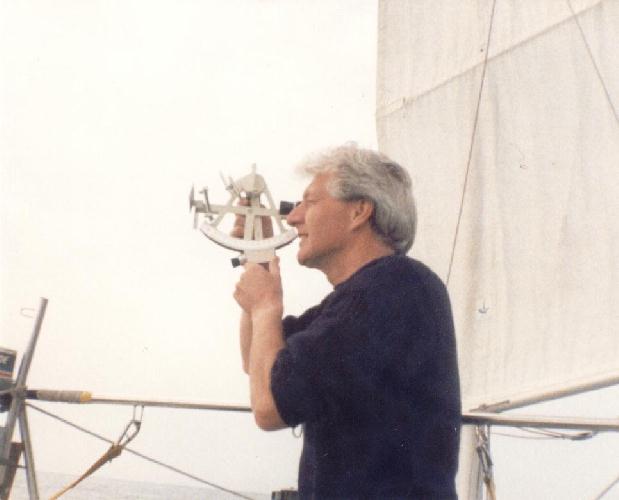
The moon was clearly visible in the early morning light and when I found a good horizon I had a go at taking a sight. The result was not encouraging because it placed us 14 miles further back than we thought we were. The conclusion was that the sight was a poor one, as I later confirmed by taking a sun sight.


I have never been able to achieve an accurate ship’s position by taking a sextant sight of the moon on account of the silvery planet’s rapid movement. Because the moon is close to the Earth, its position relative to the horizon measured as an angle between its lower limb and the horizon is difficult to capture on account of the rapidly moving planet. Accurate timing is an absolute necessary. Equally important is obtaining a precise angle in terms of degrees, minutes and seconds. The exact height of the observer’s eye above sea level is also required for a good result. Unless the shot is taken when the yacht is on the crest of a wave, a true horizon cannot be established.


While calm conditions allowed, we topped up the ship’s main fuel tank with diesel from our spare can and we also refilled the paraffin cooker. Altogether since leaving La Corunna, in addition to sailing, we had motored 81 miles. Later in the day we were again visited by porpoises, possibly the same ones who amused us earlier.


Rather frighteningly we spotted a waterspout. At first it looked like a white streak pointing down from dark menacing clouds, but very quickly it was met with a column of water rising from the sea. The area around the base was very agitated and we were rather too close for comfort. In view of the unpredictability of waterspouts and because of our fear, we immediately took in all sail, and started the engine. We kept a wary eye on what was happening, but the menacing spout did not come towards us, and it eventually collapsed.

Low 'G' deepened, giving us strong winds

Almost immediately the wind started to blow at about Force 3 from the southwest. Accordingly we stopped the engine and made sail. We noted that the barometric pressure had fallen 7 ½ millibars since midnight, and it looked as if we were in for a real blow. The B.B.C. shipping forecast for the Bay of Biscay promised south-westerly winds veering northwest 4 to 6 and perhaps gale 8 later.


Text for the Day

Matthew 10:31 ‘Do not fear therefore; you are of more value than many sparrows.’

Sunday, January 08, 2012

Cruise of the ‘Ishani’, a 26’ Eventide – Part 8

Early on the morning of Saturday, 6th June we obtained our first DF bearing which confirmed we were on track for Cape Vilano. This headland was about thirty miles south of La Corunna. We continued towards the Cape for a visual identification. In due time, an hour before nightfall, the expected hump of land appeared over the horizon. From there on, it was simply a matter of heading north and identifying lights, each with its own specific characteristic. In fact, position fixing at night was easier than by day, because positive fixes could be obtained from compass bearings of the lights. Each fix could be confirmed by checking that the distance and course run between it and the previous one was correct, taking into consideration factors such as tidal vectors, leeway, variation and deviation if applicable.

5th June

Eventually, we identified the powerful light for La Corunna, which shone brightly from the Tour de Hercule. The biggest challenge was sorting out significant lights for navigating our way into the harbour. There were numerable flashing lights which made it all a bit confusing, and to make matters worse, the whole fishing fleet was on its way to sea. As we carefully proceeded under power, we found the relevant buoys leading towards the harbour entrance. Thankfully the wind eased, which helped make the task of finding and picking up a visitor’s buoy not too difficult. Ishani entered the harbour not long after midnight. We secured the yacht to a substantial mooring buoy, dived below and took off our smelly waterproofs before cooking an enormous celebratory meal. We slept like logs until 1030 that morning of 7th June.


Surprisingly we were not visited by customs or police during the five days we were there. Formalities were minimal – all that was required was for the skipper to fill in a form giving details of the yacht and her crew. Personnel at the ‘Real Club Nautico’ made us welcome by offering the Club’s facilities which included showers, toilets, washing machines, the Club lounge and a workshop. We were only charged for the use of a mooring.

Mooring receipt

One of our biggest delights was taking a shower. After thirteen days without a freshwater body wash it was really refreshing. We did our laundry at the same time. As we were not expecting to visit Spain we did not have any local currency, but we did have our bankers’ cards which meant we could pay for telephone calls to our wives from the Hotel Finisterre. Understandably our families were relieved to know that we were well. We could not tell them of our intentions, because we had not made a decision whether to press on for the Azores, or return home.


Bill’s biological functions miraculously returned to normal. On Monday, 8th June we heard about a storm of unusual ferocity at Santander on the North coast of Spain. They experienced gusts of 80 knots causing fishing boats to be wrecked. A child on an inflatable mattress was blown out to sea. Whatever his parents were doing at the time to let him get on a lilo, I cannot imagine. A trough of low pressure moved across that part of Spain, and for us it brought warm drizzle.


We liked La Corunna because it was an interesting city of great character comprised of old and new. There were significant industrial complexes, including an oil refinery and a tanker terminal. Other things of note were a flourishing ship repair business, a Naval College, a Military Hospital and a Barracks.


In search of fresh food we found a nearby market that specialized in local produce. The ancient building had a great atmosphere. On the lower ground floor there was a fruit and vegetable market divided into many aisles. There were also stalls where all kinds of meats were sold, both fresh and processed. It seemed that the owner vendors were in friendly competition with one another. There was a raised central area, the fish market, where we bought hake. On leaving the market we were attracted to a fascinating display of sausages, of which a certain brand appealed to both of us; so we acquired some.


Bill is a better cook than me; therefore I was happy to let him prepare the evening meal which consisted of steamed hake simmered in Mother’s Pride sauce, a selection of vegetables, boiled potatoes and a glass of local wine.


On the evening of 9th June we were taken by a fellow we met on a neighbouring yacht to see the local nightspots. It seemed he had done this before. We listened to live music and we were entertained by all the comings and goings. Despite bars being open until the early hours of the morning, we didn’t see any drunks, nor did we witness any unruly behaviour.


Text for the Day

Romans 11:36 ‘Of Him and through Him and to Him are all things, to whom be glory forever. Amen.’

Saturday, January 07, 2012

Cruise of the ‘Ishani’, a 26’ Eventide – Part 7


We were greeted with fine drizzle and increasing wind early on the morning of 3rd June. In thick darkness, save for the ghosting of breaking waves, we sensed the wind had veered a little so that it was from the southwest. Despite the increase in strength of wind, the sea was smoother with longer troughs between each phosphorescent crest. At 0910 I estimated the position of the yacht to be 44 degrees 10 seconds north and 15 degrees 6.4 minutes west. For a change, we managed to hear the forecast for Sole which predicted winds from the southwest, veering west, 5 to 7, and 4 to 5 later.


As we continued, the wind steadily increased. At 1811 we recorded in the log that it was blowing more than a Force 7, perhaps an 8, because it was howling in the rigging. We had become used to these conditions. Life was as normal. We were sailing under storm jib and the mainsail was well-reefed. ‘Ishani’ behaved impeccably, rising to every wave, acting as if she were a gull bobbing on the waters of the English Channel. We were at home, two sea salts together.


4th June was our tenth day at sea. We were roughly halfway to our destination, Horta on the island of Faial. We were on track and on time for getting there in 20 days as we had planned. At this point we had a chinwag to take stock of the situation. I was feeling great and on top form. I was enjoying the challenge. Unlike my companion, I was not suffering from bouts of seasickness; neither was I having a problem opening my bowels. He on the other hand had been constipated from the outset. Laxatives had no effect. Ten days without opening his bowels was a serious situation. Furthermore, he started coughing up blood.


Things didn’t look too good. There was only one sensible option and that was to head for the nearest land. This happened to be La Corunna, in North West Spain. At midnight the decision was made to change course for the mainland which was 340 miles to the east. Everything felt quite different. Instead of beating into the wind, the ship was running. There was a sense of anticlimax, almost a feeling of failure on my part, because I had unsuccessfully tried sailing to the Azores before with two of my previous yachts, a Hunter Europa 19, and a Folksong 25. With the wind coming from astern ‘Ishani’ rolled somewhat, but her speed increased. The seas appeared to be much flatter. Hand steering became the norm because our boat would not self-steer downwind, even with only the storm jib set.


Bill wrote in his personal log that the moment the yacht was put on her new course his spirits rose. I kept my feelings to myself, but I was content with the decision, knowing we had made the right one. Sailing with a companion has its compensations: fellowship and sharing. Also help is available in tricky situations, and when there’s an emergency, two pairs of hands are better than one pair of hands. I know this for a fact, because when I was in the Bay of Biscay crewing for a friend, his yacht began to take in water faster than we could pump it out! My ideas and his actions got us out of a very serious jam. I’ll not go into details, but between us we managed to reduce the inflow of water sufficiently to keep it under control by pumping every hour.


I estimated that at our current speed we would reach land in about three days.


On 5th June we unexpectedly had the pleasure of watching several pairs of tunny leaping from wave top to wave top, as though they were participating in a choreographed dance. The barometric pressure continued to fall as the wind progressively increased in strength. We were forced to hand the main; then run before the wind under storm jib alone. With that handkerchief of a sail the boat surfed along at a good 4.3 knots. By evening the wind was at least a Force 8. We lashed the storm sail to the pulpit and lay ahull.


Laying ahull is not the most comfortable of experiences, but it invariably works. The yacht finds her own station when her tiller is slightly lashed to leeward. A slick is left upwind of the yacht which tends to smooth the seas. She heels, presenting her underbody to the waves. They smash against her side, but the yacht gives - and all is well - time after time. Parallel streaks of spume run at right angles downwind from the wave tops, and the ocean heaves. Spindrift is blown from the cresting waves. You are wedged into your bunk on the leeward side and you listen for advancing waves. They charge along like approaching express trains. You hear each explosive thud and wonder how the boat can take it, but she does. She’s like a cork rising and falling, so you give thanks to your Maker for His mercy and you wonder at His power.


Text for the Day

Psalm 106:1 ‘Praise the LORD! Oh, give thanks to the LORD, for He is good! His mercy endures forever.’

Friday, January 06, 2012

Cruise of the ‘Ishani’, a 26’ Eventide – Part 6

Noon, 1st June forecast

Bill was keeping an eye on the track of the barograph. Air pressure continued to fall. By 0130 on Monday, 1st June the wind was a good Force 7, and ‘Ishani’ was hove to on the port tack with the storm jib aback and the trysail set. She was surprisingly steady, which was just as well because we had porridge and tea for breakfast. The porridge was made with water and tinned milk, which was a devil to remove from the bowls and saucepan when it came to cleaning them in cold seawater.


After breakfast there was little we could do, except occasionally scan the horizon for shipping or other hazards. The chance of colliding with a waterlogged container or similar object was negligible; likewise becoming snarled in a discarded net was most unlikely, but I have seen abandoned crab pots and their lines that far offshore. Fishing vessels were the most likely hazards. Drifters or tunny boats fish in all weathers.


Our daily average of nautical miles sailed since leaving the Scillies worked out at 69.2. We had hoped to average at least 90 miles a day all the way to the Azores. We had another 450 miles to go, and at that rate we would take ten more days.


The near gale force wind from the southwest continued throughout the day, accompanied by fine drizzle in the morning and heavy rain in the afternoon. Mostly we lay on our bunks, ensconced in our sleeping bags. I passed the hours away by reading when I was not snoozing. Down below it was surprisingly quiet. It wasn’t until you poked your head above the hatch that you fully became aware of the shrieking wind and crashing waves. There you felt the full force of the wind on your cheeks and if you were foolish enough to wear your glasses, they would soon be caked with salt from sea spray.


Morning brought a warm front, followed in the afternoon by a cold one. Heavy rain reduced visibility to less than a mile. All of this was consistent with a fall in barometric pressure to 1,012 millibars, as recorded at midday. The wind gradually decreased in strength, and by midnight we were able to make sail again. We set the storm jib and a reefed mainsail, but the wind was from ahead, making for a lively ride. A redeeming factor was that ‘Ishani’ sailed herself with the helm lashed. We could remain below, except for the man on watch who occasionally poked his head out of the hatch to scan the horizon and check that all was well with the boat.


Tuesday, 2nd June brought hope, because we had nearly reached the halfway point between the Bishop Rock and Horta. That was confirmed by a fortuitous noon sight grabbed through an opening between the clouds. That placed us at 45 degrees, 8 minutes north and 14 degrees 49.7 degrees west, with only another 116 miles to go for a celebratory tittle - orange juice would suffice.


We pressed on, and at times the boat heeled to the extent that the trailing log mounted at the taffrail was completely submerged, but despite frequent immersions it faithfully registered miles travelled. We were pleased, because we had regained the ground we had lost while hove to. Our spirits were lifted when more breaks appeared in the cloud to the northwest and they spread in our direction. The white crests of the Atlantic rollers dramatically contrasted with a backdrop of heavy dark clouds. Wind strength fluctuated which made the steering tricky. The yacht had to be steered up and over the crests, so as not to have them smashing across the decks. A breaking wave has a lot of power that can cause serious damage. One day I was running up the English Channel during a gale aboard my Hillyard 2.5 ton yacht. A curler hit the pushpit with such force that the galvanised iron frame was bent as if it had been made of liquorice. I escaped injury because the wave threw me into the cockpit where I sat in water up to my waist.


If you experience the majesty of gale-tossed waves rolling upon the ocean’s swell, you cannot be unmoved by the grandeur of it all. The sailing was magnificent. In Bill’s words, “’Ishani’ bludgeoned her way to windward; plumes of white spray were thrown over her as she thrashed through the waves at a good speed of 3.5 knots.”


It was 1310 when we sighted a yacht on the horizon. We gave her a call on the VHF, and for ten minutes we exchanged details. She was an Australian yacht by the name of ‘Swaggie’. She was on passage from the Azores to Falmouth. We learned later that when she arrived at Falmouth her owner kindly contacted Bill’s wife to giver her news of our chance meeting.


Text for the Day

Hebrews 13:2 ‘Do not forget to entertain strangers, for by so doing some have unwittingly entertained angels.’

Thursday, January 05, 2012

Cruise of the ‘Ishani’, a 26’ Eventide – Part 5


Saturday, 30th May, and what a difference twenty four hours can make to sea conditions. Here’s the Skipper’s account:

The day dawns with drizzle. We were still hove to after an uncomfortable night. At 0934 the barometer reading was 1,019 millibar. As we had the trysail set I decided to make further repairs to the mainsail which was showing signs of wear along the seams where they chafe against the backstays. Sitting in the cabin looking down at the job brought on a further bout of seasickness.


Bill Serjeant calculated the drift for the previous 17 hours to have been 25.7 miles in a south-easterly direction. By 1145 the wind had dropped to a force 4, so the trysail was handed, and the repaired mainsail was set with one reef. (Note: In addition to roller reefing, the sail had traditional reefing pendants.) We were now sailing at our average cruising speed of 4.3 knots. Bill worked a sun sight giving us a position of 46 degrees 22 minutes north, and exactly 13 degrees west at 1500. We were actually one third of the way towards the Azores along our chosen track.


By 1600 the barometric pressure had risen to 1,023.5 millibar, which indicated there had been a rapid rise of 4.5 millibar in five-and-a-half hours, i.e., 0.8 millibars an hour. The wind gradually decreased and backed to the west. We cooked dinner in the pressure cooker. Thankfully, I managed to retain my share. As the evening drew in, a beautiful sickle-shaped moon was reflected from the ocean’s almost mirror-like surface.


Sunday, 31st May.

Here my story continues:

Sunrise heralded a gentle wind from the west. We increased sail to full main and Genoa, but we could not coax ‘Ishani’ to self-steer, which meant we had to resort to the tedious business of hand steering. We were visited by a school of porpoises that made a thorough examination of the boat. The sky was showing signs of approaching bad weather. There was alto cirrus to the west, and cumulus clouds were gathering overhead. Disturbingly there was a yellow halo around the sun. Notwithstanding these portents, the barometer continued to rise to 1,030.5 millibar. We were experiencing the calm before the storm. It seemed prudent to run the engine to charge the ship’s batteries.


Later that afternoon a beautiful black bird with a white ‘V’ on its back circled around ‘Ishani’ before heading eastwards. We were virtually becalmed, and the undulating movement of the sea frustratingly caused the sails to slat to and fro. Satisfied that the batteries were fully charged we cut the engine. From thereon we made little progress until early evening. By way of boredom, Bill grabbed the foghorn and blew into it, whereupon a whale surfaced nearby. This may have been pure coincidence, or it could have been in response to the sounding of the horn. The large but gentle creature gave us a wink, snorted through his blowhole, and disappeared into the deep, never to be seen again.


By 1705 the barograph recorded a fall of 2.5 millibar since early morning, and correspondingly the wind returned, so that ‘Ishani’ tramped along nicely under full sail, the main and both foresails.


Text for the Day

Philippians 4:7 ‘The peace of God which surpasses all understanding, will guard your hearts and minds through Christ Jesus.’

Wednesday, January 04, 2012

Cruise of the ‘Ishani’, a 26’ Eventide – Part 4

Wednesday, 27th May brought variable winds, both in direction and strength, which required much sail changing. We did not have the luxury of roller headsails, but we did have a furling mainsail. Unfortunately, to get the sail to set properly when reefed, we had to insert a wad of foam into the lower rolls. This was tedious and energy sapping, and the operation had an element of danger. Just one false move and the person doing the reefing could be over the side on account of the unpredictable movement of the boat. While doing deck work we always secured ourselves with safety harnesses that were attached to jackstays running along the side decks. Whenever we left the cabin we habitually wore safety harnesses. We made the wearing of harnesses a standing rule to be adhered to both day and night.

Me practising using the sextant two years before, when aboard 'Zeta'


Despite the rolling of the boat, I managed to obtain a good noon sight with the sextant. This enabled me to plot the ship’s position with some confidence. Slowly but surely the wind lessened and steadied from ahead, markedly reducing the boat’s speed. The weather forecast for Sole predicted static conditions with no indication of favourable winds to come. To boost our morale and charge the ship’s batteries we fired up the Yanmar, giving the yacht a tick-over speed of three knots. Neither of us liked the sound of the engine, but it was more important to make progress than to waste time getting nowhere. Altogether, the future for the next few days didn’t look promising, and for sure, we did not have enough fuel for motoring all the way to the Azores.


We had a simple routine of four hours on and four hours off combined with a dogwatch of two hours on and two hours off which gave us plenty of time for rest and for making meals. The man off watch made the main meal which was eaten in the evening after the shipping forecast. Other meals and snacks were taken individually, as and when we wanted them. I did the major part of the navigation, being responsible for plotting the ship’s position at noon and recording miles run over 24 hours.


A lot happened on the 28th May. We noticed that the clew of the mainsail required attention where the cringle was coming adrift from the sail. Bill had the appropriate thread, needles and sailmaker’s palm, and with them he repaired the sail. He washed a number of his socks by tying them to a line that he dangled over the stern. He also cleaned himself by taking a seawater shower in the cockpit. He seemed relaxed, and I think he was beginning to adjust to life at sea. Finally he washed a number of dirty dishes and disposed of a few empty cans by jettisoning them into the ocean. We watched them slowly sink until they were lost in the depths. Not surprisingly, all this activity attracted the interest of a shark that swam around the yacht. Not long before dusk an exhausted swallow landed on the cabin top, took off again and flew into the cabin where it stayed for the night.


Shortly after midnight the Autohelm packed up, but we were able to make the boat self-steer by attaching bungees to the tiller. At 0600 I plotted the yacht’s dead reckoning position on the chart and remarked to Bill that there were 4,500 metres of water under the boat. He pertinently replied that only half-an-inch of plywood was between us and the bottom! That didn’t worry me, for I had faith in ‘Ishani’, because I had seen how she had been built by my companion over a period of three years. She would hold together under the severest conditions, which was just as well, for shortly we were to experience a Bay of Biscay gale.


Text for the Day

1 Corinthians 13:13 'And now abide in faith, hope, love, these three; but the greatest of these is love.

Tuesday, January 03, 2012

Cruise of the ‘Ishani’, a 26’ Eventide – Part 3

On the morning of Monday, 25th May, we checked the shipping forecast which was for fine weather and a gentle wind from the northeast. Accordingly we phoned our wives to let them know we would be sailing that afternoon for the Azores, hoping to make landfall in about twenty days at Faial where we planned to clear customs at Horta, the capital city. This island, otherwise known as the 'Isla Azul’ (‘Blue Island’), is dominated by a 1,043 metres high volcano, the Cabeço Gordo. We were underway at 1820, and an hour later we took our departure from the Bishop Rock lighthouse.

'Zeta'

Shortly before nightfall we were visited by a large school of porpoises, perhaps the same ones that had cavorted around ‘Zeta’, my junk-rigged Folksong when I was there in 1985. They swam around the yacht at night while squealing their high-pitched notes that vibrated through the fibreglass hull. This time their calls could not be heard. We could no longer we see the loom of the Bishop Rock lighthouse, which meant we were roughly 40 miles to the southwest, well clear of land and all obstructions between us and the Azores.


On the morning of the 25th May we saw several fishing boats and deliberately kept well clear of them. Suddenly and unexpectedly we were blasted by the sonic boom of a Concord jet plane on its way across the Atlantic. We were relieved that our teeth were not shaken out of their sockets and that we were not permanently deafened by the shattering noise! All Concord aircraft were retired from service in 2003, because there were insufficient paying customers to cover the running costs. This, in part, may have come about because of the disastrous crash of an Air France Concord which was engulfed in flames when taking off at Charles de Gaulle Airport.


Not long after Concord’s dramatic flight overhead, the Taylor’s paraffin cooker took umbrage and decided it no longer wanted to work. Bill discovered that the copper feed pipe from the fuel tank had snapped. He set about repairing the break by soldering the parts together. This was a tricky business because of the motion of the boat. Having accomplished the task, he surfaced into the cockpit, leaned over the side and spewed his partially digested breakfast into the sea. From that time on he was seldom free of sickness until the 6th June when we sighted land - not the Azores, but the Spanish coast 13 days later.


Text for the Day

Romans 6:23 'The wages of sin is death, but the gift of God is eternal life in Christ Jesus our Lord.'

Monday, January 02, 2012

Cruise of the ‘Ishani’, a 26’ Eventide – Part 2

The Scillies

We were not disappointed with Watermouth, for the holding and protection were good at the anchorage between Widmouth Head and Burrow Nose. At 1430 we upped anchor and said goodbye to the delightful cove with its gently sloping woodland to the water’s edge and nearby castle. After passing Ilfracombe our course was towards Hartland Point. Progressively the wind increased and we found ourselves reducing canvas until running before it with only the small staysail. Our Autohelm did a splendid job, allowing the watchman to keep under cover out of the elements. One by one we counted off the usual markers: first, Hartland Light at 2000, followed by Bude, Trevose Head, St Ives and Pendeen.


The next morning at 0800, Round Island radio beacon was within range. By use of the DF and distance run, we were able to plot our position and lay a course towards the Scillies. The Longships Lighthouse duly appeared, confirming we were on track. Later that day the grey outlines of islands gradually emerged from an almost equally grey sea, and the closer we came to them the more sure we were of where the entrance was to St Mary’s Sound. We felt the better option for gaining access to Hugh Town was the southerly route, because we didn’t feel like the more risky one over Crow Bar at the north end of St Mary’s. We needn’t have worried, because the Island ferry, the ‘Scillonian’, goes that way at or near high water. We anchored off Hugh Town in 10 feet of crystal clear water early that evening of 23rd May.


Bill had been suffering somewhat from seasickness, but as the yacht quietly lay to her anchor he quickly recovered. After a hearty meal we both turned in and had a good night’s sleep, waking fresh the next morning. Via the VHF Bill made a radio telephone call to his wife. She was relieved to learn that all had gone well and that we had arrived safely at the Islands. She in turn promised to phone my wife confirming all was well.


Times can be anxious for relatives left behind. They can imagine all sorts of happenings, especially if the weather is unsettled, but these days mobile phones have made communications a simple matter. Fifteen years ago, things were different. Landlines were the norm. Making a phone call at St Mary’s Island would normally have entailed inflating the dinghy, rowing her to the harbour; then walking to the telephone booth. Back at the boat, the dinghy would have to be cleaned, deflated and packed away or secured to the foredeck – a lot of hassle, but the exercise would have done you good!


Text for the Day

Colossians 3:14, 15 'But above all these things put on love, which is the bond of perfection. And let the peace of God rule in your hearts, to which also you were called in one body; and be thankful.'

Sunday, January 01, 2012

Cruise of the ‘Ishani’, a 26’ Eventide – Part 1

'Ishani'

Sailing is one of those activities that draw people together in their common interest; friendships are established and strengthened by sharing. Cruising folk look to companions for adventuring together. On rare occasions, friends will co-own a vessel, share expenses, help with maintenance and cruise together. More commonly, owners of yachts will want sailing companions to crew for a cruise, or part of cruise. Both the owner and his crew benefit from joint enterprises, maybe club handicap racing, an afternoon’s sail or a cruise lasting several days.


Friends of mine have crewed for me and I have crewed for them. I was touched and delighted when Bill asked me to be his companion for a cruise to the Azores. We had cruised before and we had confidence in ‘Ishani’, as she had proven her sea-keeping qualities when we cruised to the Scilly Isles from Combwich, near Bridgwater, where the home-built Eventide was kept in a mud berth, a little more than a stone’s throw my friend’s home.


After provisioning the yacht and saying our goodbyes we cast off lines and made sail for Steart Island by Burnham-on-Sea, via the River Parrett. The time was 1450 on 21st May, 1987, and there was a light northerly, which necessitated using the Yanmar diesel auxiliary engine. Our plan was to anchor to the east of the island near number 9 starboard hand buoy. There to take rest, have a meal and get underway at midnight for the ebb down channel past Minehead, hopefully to Watermouth, arriving there at slack water. All went to plan, so we dropped anchor for a well-earned rest until the next high water. It was not profitable to motor against the fast flowing water which gurgled along the hull, occasionally brushing bladder weed against the sides.


Text for the Day

1 John 5:5 'Who is he who overcomes the world, but he who believes that Jesus is the Son of God.'


Link


Eventide Owner's Group

http://www.eventides.org.uk/