Tuesday, January 10, 2012

Cruise of the ‘Ishani’, a 26’ Eventide – Part 10

S.E. Bay of Biscay

Monday, 15th June

Today we were to experience the worst gale of the cruise. We had had more than our fair share. June and July are reckoned to be the best months for crossing the Bay with the least chance of meeting a gale, but severe gale 9s have been experienced near the coast of Spain in these summer months. Adding the ferocity of such gales is the effect a sudden change in depth of water can make. We were approximately at 46 degrees north and 4 degrees 30 minutes west, where the deep Atlantic meets the continental shelf, and soundings change from 4,000 metres to 130 metres. The Atlantic swell is forced to rise, causing the regular rhythms of waves to be broken. Most often such gales will be precipitated by the Azores High when it edges a little to the east. Winds between the high and the Spanish heat low accelerate, and they change in direction from southwest to northwest causing confused seas.

15th June

The wind progressively increased in strength, and Bill admitted to being careless when steering downwind; this resulted in several bad gybes. At the final one the bronze gooseneck by which the boom was attached to the mast broke, and as it was an essential component for keeping the boom attached to the mast, we were forced to devise a makeshift repair. Our solution was to lash the fitting with ropes to the mast and tighten them by driving wooden wedges between the lashings and the mast. By the time we finished, the wind was blowing at a good Force 7. From there onwards we ran before the wind with only the storm jib set.


Before nightfall we were about 95 miles from La Rochelle, and it seemed sensible to heave to for the night. By doing so we would maintain our sea room and we would not drift too far and too fast into shallower water where the waves would be more dangerous, even lethal. The barometer indicated a rise in pressure hinting that the worst of the gale would be over in a few hours. Meanwhile life below was interesting to say the least; crockery rattled and banged, waves hissed and crashed against the hull, but we held firmly to our bunks to stay in place while trying to relax. We had seen it all before, and I was pleased that Bill had overcome his problem with seasickness. In fact, he was quite upbeat.


At 2220 we successfully obtained a rough radio bearing of Cape Ferrate which lay to south of southeast. We also found another bearing from La Baleines Lighthouse on the Ille de Re. These bearings were insufficiently far apart to provide a reliable position, but they were better than nothing. It is preferable to have at least three bearings that exactly intersect at the yacht’s position. If they do, then the position can be accepted as reliable. A depth sounding taken at the same time will further confirm the accuracy of the plot. Navigators often forget the value of soundings. Bill and I were once caught in dense fog near St Ives, and by using soundings we were able to find our way into the harbour.


When we took radio bearings there in the Bay of Biscay our sounder gave a reading of 64 fathoms, each fathom being 6 feet. By simple calculation we were in a depth of 117 metres. One foot is 0.3084 metres; therefore we were actually into shallow waters. However, with the rise and fall of the yacht on account of the swell and the yacht’s violent movement, we could not rely on the reading.


Text for the Day

Romans 13:8 ‘Owe no one anything except to love one another, for he who loves another has fulfilled the law.’


Link


Crossing Biscay – A Weatherman’s Perspective

http://weather.mailasail.com/Franks-Weather/Crossing-Biscay-Meteorologists-Advice

Monday, January 09, 2012

Cruise of the ‘Ishani’, a 26’ Eventide – Part 9

A transcription of a page taken from the ship's log

We stayed at La Corunna until Thursday, 11th June. Our time there was pleasant enough. The barometer continued rising until the day of our departure for La Rochelle. While in port we carried out a few minor repairs, including attending to chafe on the sails. We did a bit of letter writing and enjoyed the company of other yachtsmen; most were on their way to the Mediterranean.


There can be a tendency not to want to sail. I call the condition ‘Portitis’. One becomes lethargic and there is no desire to put to sea because you know you will be exposed to its incessant movement; you know that physical expenditure will be required of you, and you are never quite sure what the sea may throw at you. Going to sea is always an ‘adventure’, which means taking part in something, the end of which you cannot be sure. Perspective changes when the boat is on her way. The crew is busy navigating and tending sails. Within hours the routine of watch keeping gives structure to the day. There are always new things to see. Life afloat is never dull. Wind and tide determine tactics, and perseverance brings success. The vessel arrives at her destination. Skipper and crew are rewarded.


The decision was made; we were to return home. Precisely at 1102 we cast off for La Rochelle. As expected, on account of high barometric pressure, there was very little wind, but by mid-day we were experiencing a rain squall that required us to put in a reef. Bill noted that the rain was warm - in his words, “ideal for growing tomatoes.” He went on to say that Spanish tomatoes are cheap because they grow profusely in such damp and warm conditions. Later that afternoon the wind fluctuated both in strength and in direction. At one time there was so little wind that we resorted to setting the large jib. All this action was making us hot and sweaty.


On the morning of 12th June we continued to the northeast, parallel to the coast before heading almost north. At 0040 it started to drizzle again –the fine sort that penetrates your waterproofs, although they have been designed not to let it in. The sea was smooth, and between 1120 and 1230 we ran the engine for a spot of mackerel fishing. To our joy we caught three - ideal for sharing between us, not too much and not too little. There’s nothing quite as tasty as fresh mackerel coated with breadcrumbs fried in a pan of olive oil, eaten within minutes of being caught. Baked beans at the same time go down well too!


Throughout the afternoon there was heavy rain and strong gusts tormented us, requiring us to reef the mainsail several times. The rain stopped at 1700, but the wind continued to fluctuate in direction. These trying conditions did not bring us joy; instead, it was hard work, but there was no cause to moan, because we had to take the rough with the smooth.


Sunday, 14th June was mostly a good day. We were about halfway across the Bay of Biscay. Underneath the boat there were 4,700 metres of ocean. The sea was flat, almost mirror-like. We motored along, averaging 3.8 knots. As the day dawned we were entertained by a large school of porpoises. These inquisitive creatures kept company with us for forty or so minutes. They frolicked at the bow, gambolled beside the yacht and made sorties away from us, only to return again. They were having fun, and so were we.


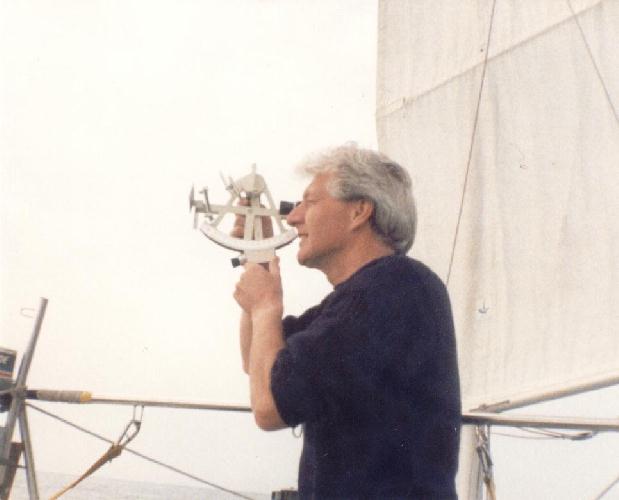
The moon was clearly visible in the early morning light and when I found a good horizon I had a go at taking a sight. The result was not encouraging because it placed us 14 miles further back than we thought we were. The conclusion was that the sight was a poor one, as I later confirmed by taking a sun sight.


I have never been able to achieve an accurate ship’s position by taking a sextant sight of the moon on account of the silvery planet’s rapid movement. Because the moon is close to the Earth, its position relative to the horizon measured as an angle between its lower limb and the horizon is difficult to capture on account of the rapidly moving planet. Accurate timing is an absolute necessary. Equally important is obtaining a precise angle in terms of degrees, minutes and seconds. The exact height of the observer’s eye above sea level is also required for a good result. Unless the shot is taken when the yacht is on the crest of a wave, a true horizon cannot be established.


While calm conditions allowed, we topped up the ship’s main fuel tank with diesel from our spare can and we also refilled the paraffin cooker. Altogether since leaving La Corunna, in addition to sailing, we had motored 81 miles. Later in the day we were again visited by porpoises, possibly the same ones who amused us earlier.


Rather frighteningly we spotted a waterspout. At first it looked like a white streak pointing down from dark menacing clouds, but very quickly it was met with a column of water rising from the sea. The area around the base was very agitated and we were rather too close for comfort. In view of the unpredictability of waterspouts and because of our fear, we immediately took in all sail, and started the engine. We kept a wary eye on what was happening, but the menacing spout did not come towards us, and it eventually collapsed.

Low 'G' deepened, giving us strong winds

Almost immediately the wind started to blow at about Force 3 from the southwest. Accordingly we stopped the engine and made sail. We noted that the barometric pressure had fallen 7 ½ millibars since midnight, and it looked as if we were in for a real blow. The B.B.C. shipping forecast for the Bay of Biscay promised south-westerly winds veering northwest 4 to 6 and perhaps gale 8 later.


Text for the Day

Matthew 10:31 ‘Do not fear therefore; you are of more value than many sparrows.’

Sunday, January 08, 2012

Cruise of the ‘Ishani’, a 26’ Eventide – Part 8

Early on the morning of Saturday, 6th June we obtained our first DF bearing which confirmed we were on track for Cape Vilano. This headland was about thirty miles south of La Corunna. We continued towards the Cape for a visual identification. In due time, an hour before nightfall, the expected hump of land appeared over the horizon. From there on, it was simply a matter of heading north and identifying lights, each with its own specific characteristic. In fact, position fixing at night was easier than by day, because positive fixes could be obtained from compass bearings of the lights. Each fix could be confirmed by checking that the distance and course run between it and the previous one was correct, taking into consideration factors such as tidal vectors, leeway, variation and deviation if applicable.

5th June

Eventually, we identified the powerful light for La Corunna, which shone brightly from the Tour de Hercule. The biggest challenge was sorting out significant lights for navigating our way into the harbour. There were numerable flashing lights which made it all a bit confusing, and to make matters worse, the whole fishing fleet was on its way to sea. As we carefully proceeded under power, we found the relevant buoys leading towards the harbour entrance. Thankfully the wind eased, which helped make the task of finding and picking up a visitor’s buoy not too difficult. Ishani entered the harbour not long after midnight. We secured the yacht to a substantial mooring buoy, dived below and took off our smelly waterproofs before cooking an enormous celebratory meal. We slept like logs until 1030 that morning of 7th June.


Surprisingly we were not visited by customs or police during the five days we were there. Formalities were minimal – all that was required was for the skipper to fill in a form giving details of the yacht and her crew. Personnel at the ‘Real Club Nautico’ made us welcome by offering the Club’s facilities which included showers, toilets, washing machines, the Club lounge and a workshop. We were only charged for the use of a mooring.

Mooring receipt

One of our biggest delights was taking a shower. After thirteen days without a freshwater body wash it was really refreshing. We did our laundry at the same time. As we were not expecting to visit Spain we did not have any local currency, but we did have our bankers’ cards which meant we could pay for telephone calls to our wives from the Hotel Finisterre. Understandably our families were relieved to know that we were well. We could not tell them of our intentions, because we had not made a decision whether to press on for the Azores, or return home.


Bill’s biological functions miraculously returned to normal. On Monday, 8th June we heard about a storm of unusual ferocity at Santander on the North coast of Spain. They experienced gusts of 80 knots causing fishing boats to be wrecked. A child on an inflatable mattress was blown out to sea. Whatever his parents were doing at the time to let him get on a lilo, I cannot imagine. A trough of low pressure moved across that part of Spain, and for us it brought warm drizzle.


We liked La Corunna because it was an interesting city of great character comprised of old and new. There were significant industrial complexes, including an oil refinery and a tanker terminal. Other things of note were a flourishing ship repair business, a Naval College, a Military Hospital and a Barracks.


In search of fresh food we found a nearby market that specialized in local produce. The ancient building had a great atmosphere. On the lower ground floor there was a fruit and vegetable market divided into many aisles. There were also stalls where all kinds of meats were sold, both fresh and processed. It seemed that the owner vendors were in friendly competition with one another. There was a raised central area, the fish market, where we bought hake. On leaving the market we were attracted to a fascinating display of sausages, of which a certain brand appealed to both of us; so we acquired some.


Bill is a better cook than me; therefore I was happy to let him prepare the evening meal which consisted of steamed hake simmered in Mother’s Pride sauce, a selection of vegetables, boiled potatoes and a glass of local wine.


On the evening of 9th June we were taken by a fellow we met on a neighbouring yacht to see the local nightspots. It seemed he had done this before. We listened to live music and we were entertained by all the comings and goings. Despite bars being open until the early hours of the morning, we didn’t see any drunks, nor did we witness any unruly behaviour.


Text for the Day

Romans 11:36 ‘Of Him and through Him and to Him are all things, to whom be glory forever. Amen.’

Saturday, January 07, 2012

Cruise of the ‘Ishani’, a 26’ Eventide – Part 7


We were greeted with fine drizzle and increasing wind early on the morning of 3rd June. In thick darkness, save for the ghosting of breaking waves, we sensed the wind had veered a little so that it was from the southwest. Despite the increase in strength of wind, the sea was smoother with longer troughs between each phosphorescent crest. At 0910 I estimated the position of the yacht to be 44 degrees 10 seconds north and 15 degrees 6.4 minutes west. For a change, we managed to hear the forecast for Sole which predicted winds from the southwest, veering west, 5 to 7, and 4 to 5 later.


As we continued, the wind steadily increased. At 1811 we recorded in the log that it was blowing more than a Force 7, perhaps an 8, because it was howling in the rigging. We had become used to these conditions. Life was as normal. We were sailing under storm jib and the mainsail was well-reefed. ‘Ishani’ behaved impeccably, rising to every wave, acting as if she were a gull bobbing on the waters of the English Channel. We were at home, two sea salts together.


4th June was our tenth day at sea. We were roughly halfway to our destination, Horta on the island of Faial. We were on track and on time for getting there in 20 days as we had planned. At this point we had a chinwag to take stock of the situation. I was feeling great and on top form. I was enjoying the challenge. Unlike my companion, I was not suffering from bouts of seasickness; neither was I having a problem opening my bowels. He on the other hand had been constipated from the outset. Laxatives had no effect. Ten days without opening his bowels was a serious situation. Furthermore, he started coughing up blood.


Things didn’t look too good. There was only one sensible option and that was to head for the nearest land. This happened to be La Corunna, in North West Spain. At midnight the decision was made to change course for the mainland which was 340 miles to the east. Everything felt quite different. Instead of beating into the wind, the ship was running. There was a sense of anticlimax, almost a feeling of failure on my part, because I had unsuccessfully tried sailing to the Azores before with two of my previous yachts, a Hunter Europa 19, and a Folksong 25. With the wind coming from astern ‘Ishani’ rolled somewhat, but her speed increased. The seas appeared to be much flatter. Hand steering became the norm because our boat would not self-steer downwind, even with only the storm jib set.


Bill wrote in his personal log that the moment the yacht was put on her new course his spirits rose. I kept my feelings to myself, but I was content with the decision, knowing we had made the right one. Sailing with a companion has its compensations: fellowship and sharing. Also help is available in tricky situations, and when there’s an emergency, two pairs of hands are better than one pair of hands. I know this for a fact, because when I was in the Bay of Biscay crewing for a friend, his yacht began to take in water faster than we could pump it out! My ideas and his actions got us out of a very serious jam. I’ll not go into details, but between us we managed to reduce the inflow of water sufficiently to keep it under control by pumping every hour.


I estimated that at our current speed we would reach land in about three days.


On 5th June we unexpectedly had the pleasure of watching several pairs of tunny leaping from wave top to wave top, as though they were participating in a choreographed dance. The barometric pressure continued to fall as the wind progressively increased in strength. We were forced to hand the main; then run before the wind under storm jib alone. With that handkerchief of a sail the boat surfed along at a good 4.3 knots. By evening the wind was at least a Force 8. We lashed the storm sail to the pulpit and lay ahull.


Laying ahull is not the most comfortable of experiences, but it invariably works. The yacht finds her own station when her tiller is slightly lashed to leeward. A slick is left upwind of the yacht which tends to smooth the seas. She heels, presenting her underbody to the waves. They smash against her side, but the yacht gives - and all is well - time after time. Parallel streaks of spume run at right angles downwind from the wave tops, and the ocean heaves. Spindrift is blown from the cresting waves. You are wedged into your bunk on the leeward side and you listen for advancing waves. They charge along like approaching express trains. You hear each explosive thud and wonder how the boat can take it, but she does. She’s like a cork rising and falling, so you give thanks to your Maker for His mercy and you wonder at His power.


Text for the Day

Psalm 106:1 ‘Praise the LORD! Oh, give thanks to the LORD, for He is good! His mercy endures forever.’

Friday, January 06, 2012

Cruise of the ‘Ishani’, a 26’ Eventide – Part 6

Noon, 1st June forecast

Bill was keeping an eye on the track of the barograph. Air pressure continued to fall. By 0130 on Monday, 1st June the wind was a good Force 7, and ‘Ishani’ was hove to on the port tack with the storm jib aback and the trysail set. She was surprisingly steady, which was just as well because we had porridge and tea for breakfast. The porridge was made with water and tinned milk, which was a devil to remove from the bowls and saucepan when it came to cleaning them in cold seawater.


After breakfast there was little we could do, except occasionally scan the horizon for shipping or other hazards. The chance of colliding with a waterlogged container or similar object was negligible; likewise becoming snarled in a discarded net was most unlikely, but I have seen abandoned crab pots and their lines that far offshore. Fishing vessels were the most likely hazards. Drifters or tunny boats fish in all weathers.


Our daily average of nautical miles sailed since leaving the Scillies worked out at 69.2. We had hoped to average at least 90 miles a day all the way to the Azores. We had another 450 miles to go, and at that rate we would take ten more days.


The near gale force wind from the southwest continued throughout the day, accompanied by fine drizzle in the morning and heavy rain in the afternoon. Mostly we lay on our bunks, ensconced in our sleeping bags. I passed the hours away by reading when I was not snoozing. Down below it was surprisingly quiet. It wasn’t until you poked your head above the hatch that you fully became aware of the shrieking wind and crashing waves. There you felt the full force of the wind on your cheeks and if you were foolish enough to wear your glasses, they would soon be caked with salt from sea spray.


Morning brought a warm front, followed in the afternoon by a cold one. Heavy rain reduced visibility to less than a mile. All of this was consistent with a fall in barometric pressure to 1,012 millibars, as recorded at midday. The wind gradually decreased in strength, and by midnight we were able to make sail again. We set the storm jib and a reefed mainsail, but the wind was from ahead, making for a lively ride. A redeeming factor was that ‘Ishani’ sailed herself with the helm lashed. We could remain below, except for the man on watch who occasionally poked his head out of the hatch to scan the horizon and check that all was well with the boat.


Tuesday, 2nd June brought hope, because we had nearly reached the halfway point between the Bishop Rock and Horta. That was confirmed by a fortuitous noon sight grabbed through an opening between the clouds. That placed us at 45 degrees, 8 minutes north and 14 degrees 49.7 degrees west, with only another 116 miles to go for a celebratory tittle - orange juice would suffice.


We pressed on, and at times the boat heeled to the extent that the trailing log mounted at the taffrail was completely submerged, but despite frequent immersions it faithfully registered miles travelled. We were pleased, because we had regained the ground we had lost while hove to. Our spirits were lifted when more breaks appeared in the cloud to the northwest and they spread in our direction. The white crests of the Atlantic rollers dramatically contrasted with a backdrop of heavy dark clouds. Wind strength fluctuated which made the steering tricky. The yacht had to be steered up and over the crests, so as not to have them smashing across the decks. A breaking wave has a lot of power that can cause serious damage. One day I was running up the English Channel during a gale aboard my Hillyard 2.5 ton yacht. A curler hit the pushpit with such force that the galvanised iron frame was bent as if it had been made of liquorice. I escaped injury because the wave threw me into the cockpit where I sat in water up to my waist.


If you experience the majesty of gale-tossed waves rolling upon the ocean’s swell, you cannot be unmoved by the grandeur of it all. The sailing was magnificent. In Bill’s words, “’Ishani’ bludgeoned her way to windward; plumes of white spray were thrown over her as she thrashed through the waves at a good speed of 3.5 knots.”


It was 1310 when we sighted a yacht on the horizon. We gave her a call on the VHF, and for ten minutes we exchanged details. She was an Australian yacht by the name of ‘Swaggie’. She was on passage from the Azores to Falmouth. We learned later that when she arrived at Falmouth her owner kindly contacted Bill’s wife to giver her news of our chance meeting.


Text for the Day

Hebrews 13:2 ‘Do not forget to entertain strangers, for by so doing some have unwittingly entertained angels.’

Thursday, January 05, 2012

Cruise of the ‘Ishani’, a 26’ Eventide – Part 5


Saturday, 30th May, and what a difference twenty four hours can make to sea conditions. Here’s the Skipper’s account:

The day dawns with drizzle. We were still hove to after an uncomfortable night. At 0934 the barometer reading was 1,019 millibar. As we had the trysail set I decided to make further repairs to the mainsail which was showing signs of wear along the seams where they chafe against the backstays. Sitting in the cabin looking down at the job brought on a further bout of seasickness.


Bill Serjeant calculated the drift for the previous 17 hours to have been 25.7 miles in a south-easterly direction. By 1145 the wind had dropped to a force 4, so the trysail was handed, and the repaired mainsail was set with one reef. (Note: In addition to roller reefing, the sail had traditional reefing pendants.) We were now sailing at our average cruising speed of 4.3 knots. Bill worked a sun sight giving us a position of 46 degrees 22 minutes north, and exactly 13 degrees west at 1500. We were actually one third of the way towards the Azores along our chosen track.


By 1600 the barometric pressure had risen to 1,023.5 millibar, which indicated there had been a rapid rise of 4.5 millibar in five-and-a-half hours, i.e., 0.8 millibars an hour. The wind gradually decreased and backed to the west. We cooked dinner in the pressure cooker. Thankfully, I managed to retain my share. As the evening drew in, a beautiful sickle-shaped moon was reflected from the ocean’s almost mirror-like surface.


Sunday, 31st May.

Here my story continues:

Sunrise heralded a gentle wind from the west. We increased sail to full main and Genoa, but we could not coax ‘Ishani’ to self-steer, which meant we had to resort to the tedious business of hand steering. We were visited by a school of porpoises that made a thorough examination of the boat. The sky was showing signs of approaching bad weather. There was alto cirrus to the west, and cumulus clouds were gathering overhead. Disturbingly there was a yellow halo around the sun. Notwithstanding these portents, the barometer continued to rise to 1,030.5 millibar. We were experiencing the calm before the storm. It seemed prudent to run the engine to charge the ship’s batteries.


Later that afternoon a beautiful black bird with a white ‘V’ on its back circled around ‘Ishani’ before heading eastwards. We were virtually becalmed, and the undulating movement of the sea frustratingly caused the sails to slat to and fro. Satisfied that the batteries were fully charged we cut the engine. From thereon we made little progress until early evening. By way of boredom, Bill grabbed the foghorn and blew into it, whereupon a whale surfaced nearby. This may have been pure coincidence, or it could have been in response to the sounding of the horn. The large but gentle creature gave us a wink, snorted through his blowhole, and disappeared into the deep, never to be seen again.


By 1705 the barograph recorded a fall of 2.5 millibar since early morning, and correspondingly the wind returned, so that ‘Ishani’ tramped along nicely under full sail, the main and both foresails.


Text for the Day

Philippians 4:7 ‘The peace of God which surpasses all understanding, will guard your hearts and minds through Christ Jesus.’

Wednesday, January 04, 2012

Cruise of the ‘Ishani’, a 26’ Eventide – Part 4

Wednesday, 27th May brought variable winds, both in direction and strength, which required much sail changing. We did not have the luxury of roller headsails, but we did have a furling mainsail. Unfortunately, to get the sail to set properly when reefed, we had to insert a wad of foam into the lower rolls. This was tedious and energy sapping, and the operation had an element of danger. Just one false move and the person doing the reefing could be over the side on account of the unpredictable movement of the boat. While doing deck work we always secured ourselves with safety harnesses that were attached to jackstays running along the side decks. Whenever we left the cabin we habitually wore safety harnesses. We made the wearing of harnesses a standing rule to be adhered to both day and night.

Me practising using the sextant two years before, when aboard 'Zeta'


Despite the rolling of the boat, I managed to obtain a good noon sight with the sextant. This enabled me to plot the ship’s position with some confidence. Slowly but surely the wind lessened and steadied from ahead, markedly reducing the boat’s speed. The weather forecast for Sole predicted static conditions with no indication of favourable winds to come. To boost our morale and charge the ship’s batteries we fired up the Yanmar, giving the yacht a tick-over speed of three knots. Neither of us liked the sound of the engine, but it was more important to make progress than to waste time getting nowhere. Altogether, the future for the next few days didn’t look promising, and for sure, we did not have enough fuel for motoring all the way to the Azores.


We had a simple routine of four hours on and four hours off combined with a dogwatch of two hours on and two hours off which gave us plenty of time for rest and for making meals. The man off watch made the main meal which was eaten in the evening after the shipping forecast. Other meals and snacks were taken individually, as and when we wanted them. I did the major part of the navigation, being responsible for plotting the ship’s position at noon and recording miles run over 24 hours.


A lot happened on the 28th May. We noticed that the clew of the mainsail required attention where the cringle was coming adrift from the sail. Bill had the appropriate thread, needles and sailmaker’s palm, and with them he repaired the sail. He washed a number of his socks by tying them to a line that he dangled over the stern. He also cleaned himself by taking a seawater shower in the cockpit. He seemed relaxed, and I think he was beginning to adjust to life at sea. Finally he washed a number of dirty dishes and disposed of a few empty cans by jettisoning them into the ocean. We watched them slowly sink until they were lost in the depths. Not surprisingly, all this activity attracted the interest of a shark that swam around the yacht. Not long before dusk an exhausted swallow landed on the cabin top, took off again and flew into the cabin where it stayed for the night.


Shortly after midnight the Autohelm packed up, but we were able to make the boat self-steer by attaching bungees to the tiller. At 0600 I plotted the yacht’s dead reckoning position on the chart and remarked to Bill that there were 4,500 metres of water under the boat. He pertinently replied that only half-an-inch of plywood was between us and the bottom! That didn’t worry me, for I had faith in ‘Ishani’, because I had seen how she had been built by my companion over a period of three years. She would hold together under the severest conditions, which was just as well, for shortly we were to experience a Bay of Biscay gale.


Text for the Day

1 Corinthians 13:13 'And now abide in faith, hope, love, these three; but the greatest of these is love.

Tuesday, January 03, 2012

Cruise of the ‘Ishani’, a 26’ Eventide – Part 3

On the morning of Monday, 25th May, we checked the shipping forecast which was for fine weather and a gentle wind from the northeast. Accordingly we phoned our wives to let them know we would be sailing that afternoon for the Azores, hoping to make landfall in about twenty days at Faial where we planned to clear customs at Horta, the capital city. This island, otherwise known as the 'Isla Azul’ (‘Blue Island’), is dominated by a 1,043 metres high volcano, the Cabeço Gordo. We were underway at 1820, and an hour later we took our departure from the Bishop Rock lighthouse.

'Zeta'

Shortly before nightfall we were visited by a large school of porpoises, perhaps the same ones that had cavorted around ‘Zeta’, my junk-rigged Folksong when I was there in 1985. They swam around the yacht at night while squealing their high-pitched notes that vibrated through the fibreglass hull. This time their calls could not be heard. We could no longer we see the loom of the Bishop Rock lighthouse, which meant we were roughly 40 miles to the southwest, well clear of land and all obstructions between us and the Azores.


On the morning of the 25th May we saw several fishing boats and deliberately kept well clear of them. Suddenly and unexpectedly we were blasted by the sonic boom of a Concord jet plane on its way across the Atlantic. We were relieved that our teeth were not shaken out of their sockets and that we were not permanently deafened by the shattering noise! All Concord aircraft were retired from service in 2003, because there were insufficient paying customers to cover the running costs. This, in part, may have come about because of the disastrous crash of an Air France Concord which was engulfed in flames when taking off at Charles de Gaulle Airport.


Not long after Concord’s dramatic flight overhead, the Taylor’s paraffin cooker took umbrage and decided it no longer wanted to work. Bill discovered that the copper feed pipe from the fuel tank had snapped. He set about repairing the break by soldering the parts together. This was a tricky business because of the motion of the boat. Having accomplished the task, he surfaced into the cockpit, leaned over the side and spewed his partially digested breakfast into the sea. From that time on he was seldom free of sickness until the 6th June when we sighted land - not the Azores, but the Spanish coast 13 days later.


Text for the Day

Romans 6:23 'The wages of sin is death, but the gift of God is eternal life in Christ Jesus our Lord.'

Monday, January 02, 2012

Cruise of the ‘Ishani’, a 26’ Eventide – Part 2

The Scillies

We were not disappointed with Watermouth, for the holding and protection were good at the anchorage between Widmouth Head and Burrow Nose. At 1430 we upped anchor and said goodbye to the delightful cove with its gently sloping woodland to the water’s edge and nearby castle. After passing Ilfracombe our course was towards Hartland Point. Progressively the wind increased and we found ourselves reducing canvas until running before it with only the small staysail. Our Autohelm did a splendid job, allowing the watchman to keep under cover out of the elements. One by one we counted off the usual markers: first, Hartland Light at 2000, followed by Bude, Trevose Head, St Ives and Pendeen.


The next morning at 0800, Round Island radio beacon was within range. By use of the DF and distance run, we were able to plot our position and lay a course towards the Scillies. The Longships Lighthouse duly appeared, confirming we were on track. Later that day the grey outlines of islands gradually emerged from an almost equally grey sea, and the closer we came to them the more sure we were of where the entrance was to St Mary’s Sound. We felt the better option for gaining access to Hugh Town was the southerly route, because we didn’t feel like the more risky one over Crow Bar at the north end of St Mary’s. We needn’t have worried, because the Island ferry, the ‘Scillonian’, goes that way at or near high water. We anchored off Hugh Town in 10 feet of crystal clear water early that evening of 23rd May.


Bill had been suffering somewhat from seasickness, but as the yacht quietly lay to her anchor he quickly recovered. After a hearty meal we both turned in and had a good night’s sleep, waking fresh the next morning. Via the VHF Bill made a radio telephone call to his wife. She was relieved to learn that all had gone well and that we had arrived safely at the Islands. She in turn promised to phone my wife confirming all was well.


Times can be anxious for relatives left behind. They can imagine all sorts of happenings, especially if the weather is unsettled, but these days mobile phones have made communications a simple matter. Fifteen years ago, things were different. Landlines were the norm. Making a phone call at St Mary’s Island would normally have entailed inflating the dinghy, rowing her to the harbour; then walking to the telephone booth. Back at the boat, the dinghy would have to be cleaned, deflated and packed away or secured to the foredeck – a lot of hassle, but the exercise would have done you good!


Text for the Day

Colossians 3:14, 15 'But above all these things put on love, which is the bond of perfection. And let the peace of God rule in your hearts, to which also you were called in one body; and be thankful.'

Sunday, January 01, 2012

Cruise of the ‘Ishani’, a 26’ Eventide – Part 1

'Ishani'

Sailing is one of those activities that draw people together in their common interest; friendships are established and strengthened by sharing. Cruising folk look to companions for adventuring together. On rare occasions, friends will co-own a vessel, share expenses, help with maintenance and cruise together. More commonly, owners of yachts will want sailing companions to crew for a cruise, or part of cruise. Both the owner and his crew benefit from joint enterprises, maybe club handicap racing, an afternoon’s sail or a cruise lasting several days.


Friends of mine have crewed for me and I have crewed for them. I was touched and delighted when Bill asked me to be his companion for a cruise to the Azores. We had cruised before and we had confidence in ‘Ishani’, as she had proven her sea-keeping qualities when we cruised to the Scilly Isles from Combwich, near Bridgwater, where the home-built Eventide was kept in a mud berth, a little more than a stone’s throw my friend’s home.


After provisioning the yacht and saying our goodbyes we cast off lines and made sail for Steart Island by Burnham-on-Sea, via the River Parrett. The time was 1450 on 21st May, 1987, and there was a light northerly, which necessitated using the Yanmar diesel auxiliary engine. Our plan was to anchor to the east of the island near number 9 starboard hand buoy. There to take rest, have a meal and get underway at midnight for the ebb down channel past Minehead, hopefully to Watermouth, arriving there at slack water. All went to plan, so we dropped anchor for a well-earned rest until the next high water. It was not profitable to motor against the fast flowing water which gurgled along the hull, occasionally brushing bladder weed against the sides.


Text for the Day

1 John 5:5 'Who is he who overcomes the world, but he who believes that Jesus is the Son of God.'


Link


Eventide Owner's Group

http://www.eventides.org.uk/

Saturday, December 31, 2011

Cruise aboard an Achilles 24

'Penelope', Geoff's Achilles

Today is New Year’s Eve and I have just come across a photo of my friend Geoff aboard his Achilles 24. The photo was tucked under a pile of clothes in a drawer. I was immediately reminded of when I took the photo at Baltimore, a small port on the southwest corner of Southern Ireland/Eire. I had been cruising with my friend Geoff, and Baltimore was the last port of call before our return to Plymouth. The cruise was memorable because of the exceptionally stormy weather. We experienced two nasty gales: the first was on the outward crossing from Falmouth to Kinsale and the second was between Baltimore and the Scillies but closer to the latter.


Geoff had never experienced being at sea in a full Force 8 and understandably he was anxious. Had we been aware of an approaching weather front we would not have set sail. The barometer gave no indication that there would be such a rapid fall of pressure, and the ship’s radio used for the shipping forecast went on the blink. By that time the sea had become so rough we had the heave to; it was dark and we were somewhere north of the Scilly Isles. At least in that position we were not likely to be in the track of shipping because the separation channels were way behind us. Visibility was very poor and there was driving rain. Needless to say, we had a very uncomfortable night.

Me shortly after seeing the whales

Next morning the wind decreased so that we were able to make good progress towards Kinsale. About twenty miles off the coast we had a fabulous encounter with a very active pod of Minke whales that encircled us, but we were not in the least frightened by their curiosity. That was the highlight of the cruise. We had two days at Kinsale before sailing to Glandore, then on to Baltimore. The coastal scenery was second to none. At Baltimore we had to delay our departure for the Scillies because of gale force winds.

Geoff steering after leaving Baltimore for the Scillies

After monitoring the weather forecasts we believed there would be a calmer spell. We set off, but twenty-four hours later we found ourselves in yet another gale at night, in almost the same spot as the previous one. The seas were more vicious, necessitating the yacht to lie-a-hull.


At dawn the wind had decreased sufficiently for us to continue towards the Scillies and our arrival was spectacular with waves breaking on the high rocks of Shipman Head to starboard and Kettle Point to port. As soon as we were in New Grimsby Harbour there was almost a dead calm, and the sun broke through the thinning clouds.


Our return to Plymouth was uneventful, except when fishing for mackerel we caught a garfish in St Mary’s Sound. We also caught more than enough mackerel for a hearty meal.


Note

I have included links to information about Achilles 24 yachts. They are remarkably fast and able yachts.


Text for the Day

Proverbs 29:25 ‘The fear of man brings a snare, but whoever trusts in the LORD shall be safe.’


Links


Achilles Yachts Owners Association

http://www.achillesyachts.co.uk/


1976 Achilles 24 Fin Keel Yacht for Sale £2,500

http://www.achillesyachts.co.uk/page72.html


1973 Achilles 24 Triple Keel Yacht for Sale £4,000

http://www.achillesyachts.co.uk/page71.html


1979 Achilles 24 Fin Keel Yacht for Sale £4,450

http://www.achillesyachts.co.uk/page73.html


Several Achilles 24 Yachts for Sale

http://www.boatshop24.co.uk/searchresults.php?channel=&manufacturer=ACHILLES+24

Friday, December 30, 2011

Laura Dekker Yet Again


While on the subject of sailing records, Laura Dekker is enjoying the warmer weather of the Southern Atlantic as she sails northwards. Having left Cape Town on 27th November, she would appear to be aiming for the Caribbean, in particular the Island of St Maarten. On arriving there she will have completed a solo circumnavigation of the Globe and she will become the youngest person to have sailed around the world in the truest sense, i.e., returning to a port of departure after crossing every meridian and having crossed the equator, completing a voyage of at least 21,600 nautical miles. In fact she will have sailed much further since setting out alone on her world cruise from Gibraltar on 21st August, 2010.


Jessica Watson is acknowledged by many as the youngest person to have circumnavigated the world alone, non-stop and without outside assistance, but according to the 21,600 miles criterion technically she misses out. Jesse Martin officially holds the record for the youngest to do a non-stop circumnavigation. To the best of my knowledge Mike Perham actually holds the record for being the youngest to have sailed solo around the world, but it looks as though Laura will shortly will take that honour.


Text for the Day

1Timothy 6:6, 7 ‘Now godliness with contentment is great gain. For we brought nothing into this world, and it is certain we can carry nothing out.’


Links


Definition of a Global Circumnavigation

http://en.wikipedia.org/wiki/Circumnavigation


Laura Dekker at Durban

http://bills-log.blogspot.com/2011/11/laura-dekker-at-durban.html


Laura Dekker, Exemplar of Youth Today?

http://bills-log.blogspot.com/2011/08/laura-dekker-exemplar-of-youth-today.html


Mike Perham, Jessica Watson, Abby Sunderland and Laura Dekker

http://bills-log.blogspot.com/2010/05/mike-perham-jessica-watson-abby.html


Laura Dekker again

http://bills-log.blogspot.com/2011/02/laura-dekker-again.html


Laura Dekker

http://bills-log.blogspot.com/2009/09/laura-dekker.html


Laura Dekker

http://en.wikipedia.org/wiki/Laura_Dekker


Laura Dekker Arrives in St. Maarten after 17 Days

http://nasailor.com/2010/12/23/laura-dekker-lands-makes-it-to-st-maarten/


The Laura Dekker Report: Laura is sailing north towards the Caribbean!…

http://blog.jetsettingmagazine.com/?p=23320


Jessica Watson

http://www.jessicawatson.com.au/


Jessica Watson to miss sailing record

http://news.ninemsn.com.au/national/1048582/no-record-for-jessica-watson


Mike Perham

http://en.wikipedia.org/wiki/Michael_Perham


Jesse Martin

http://en.wikipedia.org/wiki/Jesse_Martin

Thursday, December 29, 2011

Micro 10’ Sailboat for Global Circumnavigation Part 2


Following on from yesterday’s blog I have a few more thoughts about the type of vessel Sven may design. For some reason he has decided on a length of 10’ which is small for such a venture. Maybe he has chosen that length because he made mention of the Around in Ten Race which never took place. Originally there were a number of aspirants who intended racing around the world in 10 sailboats, but for various reasons none were able to make it to the start line.


The challenge still remains for someone to succeed in doing a circumnavigation in a smaller boat than the smallest, i.e., Serge Testa’s, ‘Acrohc Australis’. She was 11’ 10” long. Ten feet would be pushing it to the absolute limit, on account of internal space for a solo sailor and his provisions. This would not be a non-stop attempt. On that basis, if Sven were to succeed, he most likely would become the ultimate winner of a world record, but I feel sure he would not be looking for accolades or approval on that account. He says he wants to celebrate 50 years of his life during which time he has sailed across oceans aboard small boats, most of them designed and built by him. A solo circumnavigation in the smallest of boats would be his way of celebrating.


Yesterday I suggested Sven’s new boat may turn out to be a bit like Paul Fisher’s Micro 10. Well, that was in profile, not in terms of 3-dimensional form. Instead of having double chines she may have single chines on each side and she may have chine runners as per his present boat. She could even be a round bilge boat, although I doubt it, because his preferred building method is sandwich composite which does not easily lend itself to multiple curved structures.


I also suggested his new boat may be fitted with a skeg to help with downwind sailing, but I remember that he locked the rudder of his present boat, which in effect became a versatile skeg that could be used in conjunction with the sails to bring about equilibrium for maintaining a steady course. His boat may also dispense with a conventional keel because it would not help when lying to a sea anchor or drogue.


One of the biggest problems with small boats is keeping them dry inside. If the crew is to maintain his health over a period of many months he must keep his body dry and warm. On that account, I doubt Sven will swim in the cold waters of the Southern Ocean as he did in the warmer waters of mid Atlantic. He has already perfected a system of watertight vents for providing fresh air within an otherwise sealed cabin, but for this 10’ boat he will need to insulate the interior for maintaining a bearable temperature. Some form of heating may be required, which could pose a problem for the storage of fuel to power a heater. Top quality thermal clothing may be the solution obviating the need for a heater.


Note

Just a thought – Do you think a scaled-down 10’ version of a John Welsford ‘Fafnir’ might fit the bill for a solo circumnavigation record attempt at being the smallest? I wouldn’t choose to sail south of the Great Capes, however. I suggest this as food for thought - not a recommendation. John would give an honest opinion.


Text for the Day

Matthew 5:37 ‘…….. let your ‘Yes’ be ‘Yes,’ and your ‘No’ be ‘No.’ …………………’


Links


Around in Ten

http://www.aroundinten.com/


Serge Testa aboard ‘Acrohc Australis’

http://www.acrohc.com/


‘Acrohc Australis’

http://bills-log.blogspot.com/2009/11/acrohc-australis.html


Upwind in Small Sailing Cruisers

http://bills-log.blogspot.com/2010/04/upwind-in-small-sailing-cruisers.html


Solo Circumnavigation Record Attempts

http://bills-log.blogspot.com/2009/10/solo-circumnavigation-record-attempts.html


‘Fafnir’ by John Welsford

http://www.jwboatdesigns.co.nz/plans/fafnir/index.htm


Boatbuilding Sailing Blog

http://fafnirsailboat.blogspot.com/

Wednesday, December 28, 2011

Micro 10’ Sailboat for Global Circumnavigation

'Yrvindaren 4.1'

You will note from yesterday’s blog that Sven Yrvind has announced that he intends designing and building a 10’ micro yacht for making a single-handed voyage south of all three great capes, i.e., Cape Agulhas, Cape Leeuwin and Cape Horn. In so doing he would also sail south of the Cape of Good Hope, South West Cape of Tasmania, and the South East Cape of Tasmania.


Many of us will be itching to learn about the design of his new boat. For sure, she will not be like ‘Yrvindaren 4.1’, because there would not be sufficient room for Sven and his provisions for a period of 12 months, which is the time he believes it will take. She could be a shortened version of his latest hard chine micro yacht, but with more internal volume brought about by increasing the height of her sides and by fully extending the upper cabin structure to the width of her full beam. He has said his next boat will have an aft steering position, in preference to the central one of ‘Yrvind.com’.


This new vessel will essentially be a downwind drifting ‘pod’ capable of withstanding large breaking waves characteristic of the Southern Ocean. Yrvind will want to avoid icebergs; therefore his passage will be far enough north to be clear of them. These factors will require that his tiny boat can be sailed with the wind on her quarter and she must have reserve buoyancy in the bow, which will require a fairly full, possibly spoon shaped bow. There may be times when the sea state is extremely rough because of winds well in excess of Force 8, in which case, Sven may opt for a series drogue for riding out the seas. In fact much of the voyage could be sailed backwards at a leisurely pace while Sven is wedged in a secure seat, even strapped into it, no doubt reading his choice non-fiction books.


For sailing downwind, a skeg at the stern would help orientate the bow away from the wind, and a mast forward of the centre would enable very small twin boomed headsails to be deployed so as to form a ‘V’ facing into the wind, which would also keep the boat pointing downwind. Both clews could have sheets attached to the tiller for simple self-steering. A long keel would be helpful for maintaining directional stability and for minimizing yawing.

Micro 10

All of these requirements make me think Sven’s new boat may look a bit like Paul Fisher’s Micro 10, but I doubt he will go for a lifting keel. On the other hand, he may want a keel of sorts, perhaps shallow twin keels for when making into land to find a safe haven. He does not rule out stepping on terra firma, and if there is a suitable place where he can safely get ashore, he may want to, in his own words ‘stretch his limbs’.


Text for the Day

1 Corinthians 2:9 ‘But as it is written: “Eye has not seen, nor ear heard, Nor have entered into the heart of man The things which God has prepared for those who love Him.”’


Links


Great Capes

http://en.wikipedia.org/wiki/Great_capes


‘Yrvindaren 4.1’

http://bills-log.blogspot.com/2009/11/yrvindaren-41.html


Paul Fisher Boats

http://www.selway-fisher.com/


10’ Ocean-going Sailboat Designs

http://bills-log.blogspot.com/2010/04/10-ocean-going-sailboat-designs.html


Solo Circumnavigation Record Attempts

http://bills-log.blogspot.com/2009/10/solo-circumnavigation-record-attempts.html

Tuesday, December 27, 2011

Sven Yrvind


Of all the small sailboat sailors, Sven is perhaps the most remarkable. You only need look at my previous articles to learn more about him. (See links below.) Like one of the early small sailboat sailors, John MacGregor, he is an excellent self-promoting publicist, an individual who has influenced many people by his exploits at sea, and by lecturing and by writing.


Not a man who rests upon his laurels and one with boundless energy at the age of 72, he has published at his website his latest plans.* He intends designing and building a 10’ boat to sail non-stop around the world. His definition of a global circumnavigation differs somewhat from the more common one, i.e., a passage of at least 21,600 nautical miles (40,000 km) crossing the equator and every meridian, finishing at the same port as that of departure. Sven’s definition is a voyage that crosses ‘all the meridians’ like that of Vito Dumas. He completed a voyage from Buenos Aires to Buenos Aires east-about, passing south of the great capes.


Sven plans on spending one year at sea, and for bodily sustenance he will take with him 400 kilos of food. For mental stimulus he will have a library of 100 non-fiction books – useful ballast! His mission will be to ‘sail east about, south of the great capes: Cape Horn, Cape of Good Hope, etc.’


Text for the Day

Hebrews 9:27, 28 ‘And as it is appointed for men to die once, but after this judgment, so Christ was offered once to bear the sins of many. To those who eagerly wait for Him He will appear a second time, apart from sin, for salvation.’


Links


*Sven Yrvind

http://www.yrvind.com/present_project/


Sven Yrvind, Ocean Sailor and Yacht Designer

http://bills-log.blogspot.com/2011/12/sven-yrvind-ocean-sailor-and-yacht.html


Martinique – Fort-de-France - Sven Yrvind

http://bills-log.blogspot.com/2011/11/martinique-fort-de-france-sven-yrvind.html

Out of Sight, but not out of Mind –Sven Yrvind

http://bills-log.blogspot.com/2011/11/out-of-sight-but-not-out-of-mind-sven.html


Sven Yrvind Sails Again

http://bills-log.blogspot.com/2011/08/sven-yrvind-sails-again.html


Sven Yrvind

http://en.wikipedia.org/wiki/Sven_Yrvind


'Rob Roy' Yawl (John MacGregor)

http://bills-log.blogspot.com/2009/11/rob-roy-yawl.html


‘Rob Roy’ Canoes (John MacGregor)

http://bills-log.blogspot.com/2009/11/rob-roy-canoes.html


John MacGregor

http://en.wikipedia.org/wiki/John_MacGregor_(sportsman)


Definition of a Global Circumnavigation

http://en.wikipedia.org/wiki/Circumnavigation


Vito Dumas

http://en.wikipedia.org/wiki/Vito_Dumas

Friday, December 23, 2011

Popular Pages at Bill’s Log

StatCounter stats

Satisfaction is had from writing a blog by knowing there are readers who enjoy reading it. Over the past two or more years I have kept an eye on the number of page loads, unique visitors and returning visitors to the website. On all counts they have increased. Between 60 and 80 regulars faithfully log on every day. Unique visitors generally amount to over 300 a day, and page loads can be between 500 and 700.


Statistics are from http://statcounter.com for which I am very grateful, especially as they are provided free of charge.


Current popular pages are:


Drascombe Coaster http://bills-log.blogspot.com/2010/12/drascombe-coaster.html


10’ Micro-yacht Globetrotters http://bills-log.blogspot.com/2010/04/10-micro-yacht-gobetrotters.html


An Archive Page http://bills-log.blogspot.com/2010_04_01_archive.html


Another Archive Page featuring Harry Pigeon http://bills-log.blogspot.com/2009_12_01_archive.html


‘Elusion’, Matt Layden’s Micro-sailboat http://bills-log.blogspot.com/2010/03/elusion-matt-laydens-micro-sailboat.html


Small Sailboats that have crossed the Atlantic http://bills-log.blogspot.com/2010/04/small-sailboats-that-have-crossed.html


One thing to be noted is that all of the popular pages have as their subject matters, yachts, boats, or sailors.


Without readers, doing a blog is almost a pointless exercise; therefore I want to take this opportunity to thank you all for your support and to wish you a very Happy Christmas.


I shall be offline for the next two or three days as I take a festive break.

Thursday, December 22, 2011

Win a Range Rover Evoque Prestige


The Best of the Best Win a Supercar competition for a Range Rover Evoque Prestige was taking place at Lakeside when I happened to be there accompanying my wife who was looking for a Christmas present.


I could not but notice this strange car which was parked by the 3 Store within the inner concourse on the ground floor. I felt there was something inherently wrong with its appearance, because the roof looked as if it had been squashed down at the back, but that was an optical illusion. In fact the roof was almost horizontal and parallel to the ground. The odd visual effect was caused by the shape of the windows which narrowed towards the rear of the car.


The front end looked like the head of a monster with shark-like eyes (headlamps) and a mouth full of sharp teeth (grill) for tearing me apart. I was distinctly uneasy in its presence. Everything about the car was macho – a bionic machine with bulging muscles like those of Mr Universe. Get in its way, you wouldn’t stand a chance.


At £5 a time for entering the competition, a spot the ball interactive computerized game of skill, you will be throwing your money away except for a small portion that will go to a charitable cause. Consider the matter - since 2005 B OT B has donated £117,000, but the Plc has raised 2 million pounds (net of expenses)!


Text for the Day

Matthew 6:1‘Take heed that you do not do your charitable deeds before men, to be seen by them. Otherwise you have no reward from your Father in heaven.’


Links


All new Range Rover Evoque 2011 Driving

https://www.youtube.com/watch?v=1_l4pihZnUI&feature=player_embedded#


This link takes you to the Best of the Best Website for the Competition

http://www.botb.com/SupercarCompetitionDetails/309ca6ac-572c-4865-8ec1-ef4cee9e44f8/December+Supercar+Competition

Wednesday, December 21, 2011

Nativity Cribs

Charity Nativity Crib at Lakeside shopping centre

Traditional nativity cribs usually contain modelled or carved figures representing biblical characters associated with the account of the birth of Jesus. These figures are invariably arranged around a centrally placed baby Jesus who is laid in a manger on the floor of an open barn-like structure. For a complete assembly there are usually figures representing the baby Jesus, Mary His mother, Joseph His legal father, three Wise Men (Magi), the Angel Gabriel, at least one shepherd, a donkey, a cow, and perhaps a couple of sheep.

Nativity Crib figures for sale at Alton Garden Centre

More correctly a nativity crib should contain a number of figures representing shepherds who had been visited by ‘an angel of the Lord’* when they were keeping watch over their sheep. He told them that they would find the Babe (Jesus) in a manger. They went to Bethlehem and found Him there along with Mary and Joseph, just as the angel had said they would. Afterwards the shepherds told many people about their experiences before returning to their abandoned sheep.

Painted resin figures for auction at Ebay

The Magi, not necessarily three, because no mention is made of their number, actually visited the young Child later, when He and his parents were in a house;** they worshipped Him and presented Him with gifts of gold, frankincense, and myrrh.

Stylized painted wooden figures for sale on the Internet

So, strictly speaking, a nativity crib should only contain a number of figures representing shepherds, the Christ Child and His parents. On the other hand, it would appear that artists or craftsmen creating these things, do so with artistic licence, and include figures associated with events before and after the Boy’s birth.


*Luke 2:9 **Matthew 2:10


Text for the Day

Luke 2:12 ‘And this will be a sign to you: You will find a Babe wrapped in swaddling cloths, lying in a manger.’


Links


There is a photo of a life-size Nativity Scene at my blog here:

http://bills-log.blogspot.com/2011/01/mexican-holiday-7th-day.html

Tuesday, December 20, 2011

Christmas 1944

Today's market place

My sister lived in Bristol. Her husband was away in the Malayan or Burmese jungle (I know not which) fighting alongside Ghurkhas, crawling through leach-infested jungle in the service of his Country. My mother and father sent me off to Bristol Temple Meads Station where I was met by my sister, my eight year old niece and her younger brother. I had a label tied to my lapel as if I was a parcel and I was placed under the charge of the train guard who was responsible for the contents of the guards van. It was a steam locomotive in those days. He carried red and green flags attached to short-handle staves. He waved the green one for the driver to start the train and quickly joined me in the van.

Artificial trees galore!

My sister lived in a small terrace house, which was a fifteen minute bus ride from the station. I thought her house was antiquated with its gas lighting. Even the street lamps were powered by gas, and before nightfall they were lit by the local lamplighter. He had a long pole with a flint striker at the top, and a hook for turning the gas on and off. Coal and wood fires provided heat in the house. That Christmas was my first away from home, but I was not in the least fretful, for I had the company of my niece and nephew, and a loving sister who was more like a second mother.

Santa

There was a real Christmas tree in the corner of the back room. It was decorated with tiny candles clipped to the ends of its branches, and there were also colourful baubles hanging from threads tied to the branches. Flickering flames from a Yule log were reflected from the tiled hearth. A long embroidered mantel was draped over a wrought iron shelf above the fireplace upon which there were a number of Christmas cards. Overhead paper chains were looped from each corner of the ceiling to a central roundel from which a pendant gas light hung.


My sister busied herself frying eggs and chips while we children were left to play. All of a sudden there was a loud crackling from the fireplace, and immediately one end of the mantle was alight. In alarm I called my sister who rapidly brought a bowl of water into the room and doused the flames. She calmly removed the remains of the mantel, replaced the cards and cleaned the hearth. Finally, she covered the fireplace with a metal mesh guard. The house could have been an inferno within minutes had she not acted so promptly.


It was Christmas Eve. Each of us was given a nylon stocking which we hung on the end of our metal frame beds. I slept in the box room. Early on Christmas morning we were woken by my sister and we eagerly found our stockings which we were not permitted to open until we gathered on the large double bed in the front bedroom. It was still dark outside. The gas lamp fluttered as it cast its feeble yellow glow. We groped inside our stockings and pulled out one item at time. They all contained identical articles: a small bag of liquorice allsorts, a party horn that made a duck-like quacking sound, a packet of wax crayons, a paper bag filled with hard-boiled sweets, a Christmas hat and an orange. In addition to our stockings there were parcels for sharing. We eagerly tore them open to reveal, cardboard puzzles, games of Snakes and Ladders, Ludo, Tiddlywinks, Draughts and drawing books.


Candles on the tree were carefully lit at dinnertime and again at teatime, but only for ten minutes or so at each meal. There was Christmas pudding with silver threepenny bits hidden in it at both meals. We played all day and had much fun. Our Christmas was to us a wonderful time, and over sixty years later, I remember it so well.


Note

Illustrations are of stuff sold today.


Text for the Day

Luke 2:10, 11 'Then the angel said to them, "Do not be afraid, for behold, I bring you good tidings and great joy which will be to all people. For there is born to you this day in the City of David a Saviour, who is Christ the Lord.'

Monday, December 19, 2011

Commercialism of Christmas

£399.00 - The real Babe is for free!

Christmas has been hijacked by those who would make a profit by cashing-in on the vulnerable who are duped by their salesmanship. The whole meaning of Christmas has been distorted and twisted, far removed from the real Christmas story, which in truth is not a story, but a fact of history: God’s Son was born of a virgin in the filth of a stable. Now that’s an incredible, but true fact. Equally true, this Child was just like any other male infant, except He was born without sin. His mission was to reveal the love of His Father for all mankind, and by His death on a cross to make a way possible for those who would believe in Him to receive His love with great joy.


Don’t be taken in by all the hype, the glitter and tinsel, the hollowness of things here and now that fade and are no more. Take this opportunity to discover the real Babe who was laid in a manger. Get hold of a Bible and read the account, even read the facts by going online at: http://www.biblegateway.com


Text for the Day

Luke 2:7 ‘And she brought forth her firstborn Son, and wrapped Him in swaddling cloths, and laid Him in a manger, because there was no room for them in the inn.’